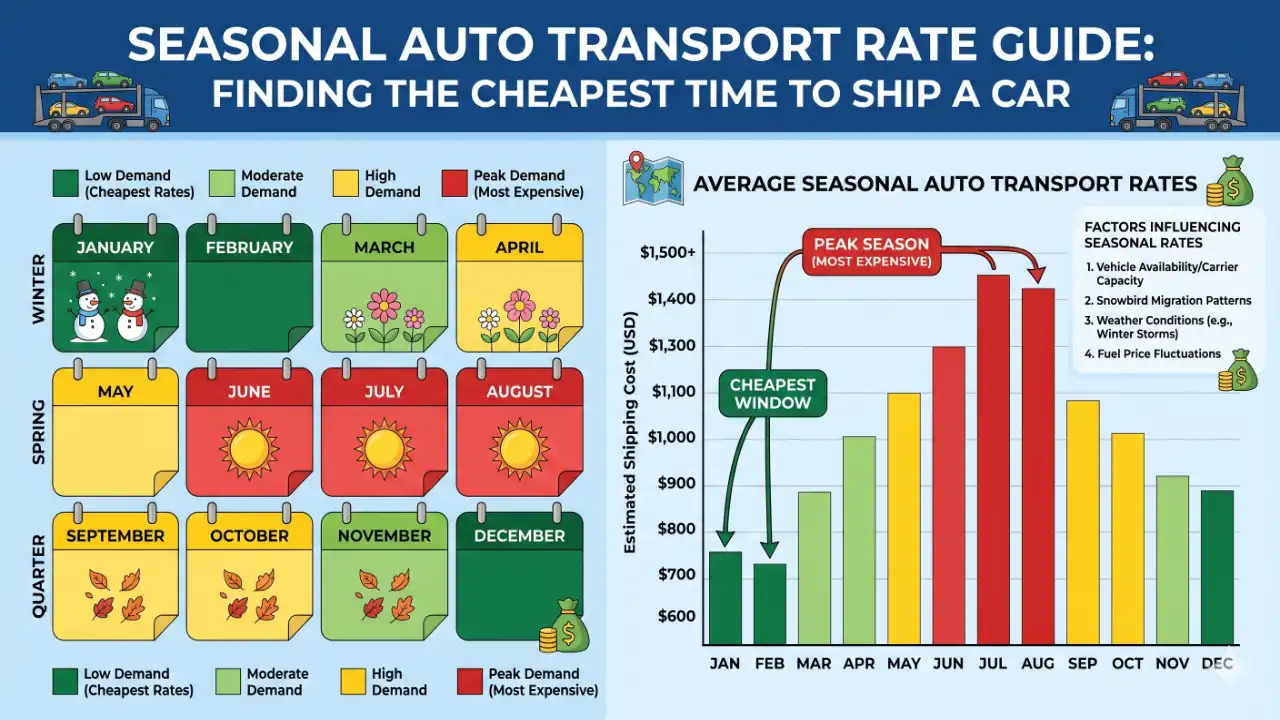
The cheapest time to ship a car is not random luck — it follows a very predictable pattern. Auto transport rates rise and fall like airline tickets, driven by snowbird migrations, college move-ins, military PCS seasons, and regional weather. If you know what months to target, you can cut your bill by 20 to 30 percent compared to peak season pricing.
This guide breaks down every single month so you know exactly when to pull the trigger — and when to wait. We'll also tell you which routes swing the hardest and why your pickup truck costs more than a Civic to move.
Why Car Shipping Rates Change With the Season
Carrier availability drives pricing more than anything else. When more trucks chase fewer cars, prices drop. When shippers flood the market with vehicles, drivers get to pick and choose — and rates climb.
Three forces move the market throughout the year:
- Snowbird migration: Retirees driving the October-to-December southbound surge on I-75 and I-95, then reversing in April and May.
- College and university cycles: August move-ins and May move-outs generate massive regional spikes near large campuses.
- Military PCS orders: Most permanent change-of-station orders activate between May and September, flooding popular corridors with POV (privately owned vehicle) shipments.
Miss one of these surges and you'll pay premium rates. Catch the off-season on your route and you'll find carriers actively competing for your load.
The Cheapest Time to Ship a Car: January and February Win Almost Every Year
Outside of snowbird corridors, January and February are the slowest months in auto transport. Consumer demand drops sharply after the holiday rush. Dealers and auction houses aren't moving as much inventory. Carriers sitting idle in the Midwest and Northeast need loads — any loads — to stay profitable.
That driver competition is your advantage. On routes like Midwest to Mountain West or Northeast to Texas, you can realistically expect rates that are $200-$350 below summer pricing for a standard sedan.
Insider Tip: Book in January and request a terminal-to-terminal drop if there's a depot near you. Terminal meets eliminate the driver's detour time and often shave another $75-$100 off your quote. Car Shipping Hub's dispatch team can confirm which terminals are active on your corridor.
The one exception? Florida-bound routes. Snowbirds from Michigan, Ohio, and Ontario flood I-75 southbound from October through December and return north in April and May. On those specific lanes, winter pricing is not cheap — it's peak season pricing in disguise.
Month-by-Month Rate Outlook for Auto Transport
Use this breakdown as your planning calendar. Rates are relative to annual average on non-snowbird routes for a standard mid-size sedan on open carrier.
| Month | Rate Level | Vs. Annual Average | Key Driver |
|---|---|---|---|
| January | Very Low | -20% to -30% | Post-holiday demand drop, idle carriers |
| February | Very Low | -15% to -25% | Winter slow season continues |
| March | Low to Moderate | -10% to -15% | Spring auction season begins |
| April | Moderate | -5% to +5% | Snowbird northbound return, spring ramp-up |
| May | High | +10% to +20% | Military PCS orders, college move-outs |
| June | Very High | +20% to +35% | Peak relocation season begins |
| July | Very High | +20% to +35% | Summer peak, dealer inventory movement |
| August | Very High | +25% to +40% | College move-ins, highest demand of year |
| September | High | +10% to +20% | Post-summer taper, still elevated |
| October | Moderate to High | +5% to +15% | Snowbird southbound surge begins |
| November | Moderate | 0% to +10% | Mixed — snowbird lanes hot, others cooling |
| December | Low to Moderate | -5% to -15% | Non-snowbird demand drops before holidays |
Summer Is the Most Expensive Window — Here's the Real Reason
June through August is the most expensive stretch of the year for shipping a car. The reason isn't just high demand. It's that multiple demand spikes hit at exactly the same time.
Military families execute the bulk of their PCS moves between May and August. The DOD processes hundreds of thousands of active-duty relocations annually, and most orders land in late spring. That alone floods corridors near Fort Liberty (North Carolina), Fort Cavazos (Texas), Fort Bragg, and Camp Pendleton (California) with POV transport requests.
College move-ins compound the problem in August. Universities near major metro areas — think Columbus, Austin, Gainesville, and Tempe — generate thousands of car shipments in a three-week window. Carriers know this and price accordingly.
On popular summer routes, expect to pay $1,050-$1,600 for a sedan and $1,350-$2,100 for an SUV or truck. If you have any flexibility at all, waiting until September or booking in February will save you real money.
Why Your SUV Costs $200-$350 More Than a Sedan Year-Round
Every carrier trailer has a finite number of load slots. A standard open carrier holds 7-10 vehicles. Your full-size SUV, truck, or minivan burns two slot widths or occupies premium vertical space — especially on the upper deck.
Drivers price by the slot, not just by the mile. A Ford F-150 crew cab costs more to haul than a Honda Civic on any route, any season. Oversized vehicles also carry higher risk of curb damage during loading, which factors into the carrier's risk assessment.
If you're shipping an oversized vehicle, Car Shipping Hub's cost calculator will show you real-time estimates based on your exact vehicle dimensions — not just a ballpark.
Pro Tip from Dispatch: Shipping a lifted truck or a vehicle with a roof rack? Tell your broker before booking. Those add-ons affect trailer clearance. A driver who doesn't know ahead of time may refuse the load at pickup, costing you a delay and a rebooking fee.
The 3 Routes That Swing the Most Between Peak and Off-Season
Not every route fluctuates equally. Some corridors have extreme seasonal swings. These three move the most:
- Northeast to Florida (I-95 South): The most volatile lane in the country. October through December sees 30-40% rate spikes as snowbirds from New York, New Jersey, and New England flood the southbound queue. By February, northbound lanes are cheap while southbound stays expensive. Full reversal hits in April and May.
- Midwest to Mountain West (I-70 / I-80): Calm in winter (cheap), chaotic in summer as outdoor recreation enthusiasts and Denver-area corporate relocations stack up. August rates on this lane run 25-30% above the January floor.
- California to Texas (I-10 East): Driven by tech and energy sector relocation cycles. Surprisingly volatile in June and July. The westbound return (Texas to California) is often cheaper — drivers prefer returning loads.
Knowing your route's specific pattern matters more than following a generic seasonal calendar. Our team at Car Shipping Hub tracks lane-specific pricing daily — reach out to confirm the current trend on your exact corridor before you book.
5 Dispatcher Tricks That Cut Your Transport Bill by Up to 20%
Timing is the biggest lever, but it's not the only one. Use these tactics to squeeze more savings out of any month.
- Book 2-4 weeks out, not 1-2 days out: Last-minute bookings cost more because brokers have limited carrier options. Give dispatchers a 2-3 week window and you'll see better carrier competition for your load.
- Choose open carrier over enclosed: Enclosed transport costs 40-60% more than open. Unless you're shipping a classic, exotic, or high-value vehicle, open carrier is perfectly safe for 95% of shipments.
- Be flexible on pickup and delivery dates: A 3-5 day flexibility window gives dispatchers room to find the right carrier going your direction — often a driver who's already loaded near your origin and needs a final slot filled.
- Ship mid-week, not Friday: Weekend pickups are harder to schedule. Drivers prefer Tuesday-Thursday loads because it keeps their delivery windows in working business days.
- Ask about terminal-to-terminal options: Dropping your car at a local terminal and picking it up at a destination terminal removes the residential detour for the driver. That savings often flows back to you as a discount.
Our trusted partner Furious Auto Shipping works the same corridors and applies these same booking strategies to minimize cost without cutting corners on carrier quality.
How to Lock In an Off-Peak Rate Even During Peak Season
What if you have to ship in June or August? You're not completely stuck. A few moves can still bring your rate down.
First, target the backhaul direction on your route. If everyone ships from Chicago to Miami in summer, try to find a broker who runs the reverse lane and is padding loads. Florida-to-Midwest in July is cheaper than Midwest-to-Florida because fewer people are going north in summer.
Second, avoid the first two weeks of August. College move-ins spike during that window. The third and fourth weeks of August see a sharp drop-off as campuses fill. Even a two-week delay can save $150-$250 on common routes.
Third, understand how the dispatch process works so you can communicate intelligently with your broker. Knowing what a Bill of Lading is, what your carrier's MC number means, and why pre-inspection photos matter makes the whole transaction faster — and shows the broker you're an easy customer worth prioritizing.
Frequently Asked Questions
What is the absolute cheapest month to ship a car?
January is typically the cheapest month for auto transport on most routes. Demand drops sharply after the holiday season, carriers have fewer loads, and drivers compete for your vehicle. Rates in January run 20-30% below the summer peak on non-snowbird corridors.
How much can I save by shipping in the off-season?
On a typical cross-country route, the difference between peak (August) and off-peak (January) pricing runs $200-$450 for a standard sedan on open carrier. Larger vehicles and specialty routes can see even wider swings. Car Shipping Hub can show you current lane-specific pricing before you commit.
Is it cheaper to ship a car from Florida to the Northeast in winter or summer?
Southbound (Northeast to Florida) is cheapest in summer when snowbirds are absent. Northbound (Florida to Northeast) is cheapest in winter for the same reason. These lanes flip dramatically — always check the direction, not just the season.
Does booking early actually save money on auto transport?
Yes. Booking 2-4 weeks ahead gives brokers time to find carriers heading your direction at a competitive rate. Last-minute bookings (1-3 days out) often cost $100-$200 more because your options narrow quickly and drivers know it.
Is open carrier safe enough for a regular car during winter months?
For most vehicles, yes. Open carriers handle millions of cars in winter without incident. Drivers are experienced with road salt and cold weather loading. If you have a classic, convertible, or exotic vehicle, enclosed transport is worth the premium any time of year.
How long does it take to ship a car across the country?
Most long-distance shipments move at roughly 400-500 miles per day once the carrier loads your vehicle. A Los Angeles to New York run typically takes 7-10 transit days. Shorter regional routes of 500-1,000 miles usually deliver in 2-4 days.
Ready to Ship at the Best Rate for Your Route?
You now know exactly when the market is in your favor — and when it's not. The next step is getting a number tied to your specific route, vehicle, and timeline.
Get Your Free Quote from Car Shipping Hub and see real-time pricing on your corridor. Our dispatch team can confirm whether you're in a peak window or an off-season lull — and help you find the fastest path to the best rate.