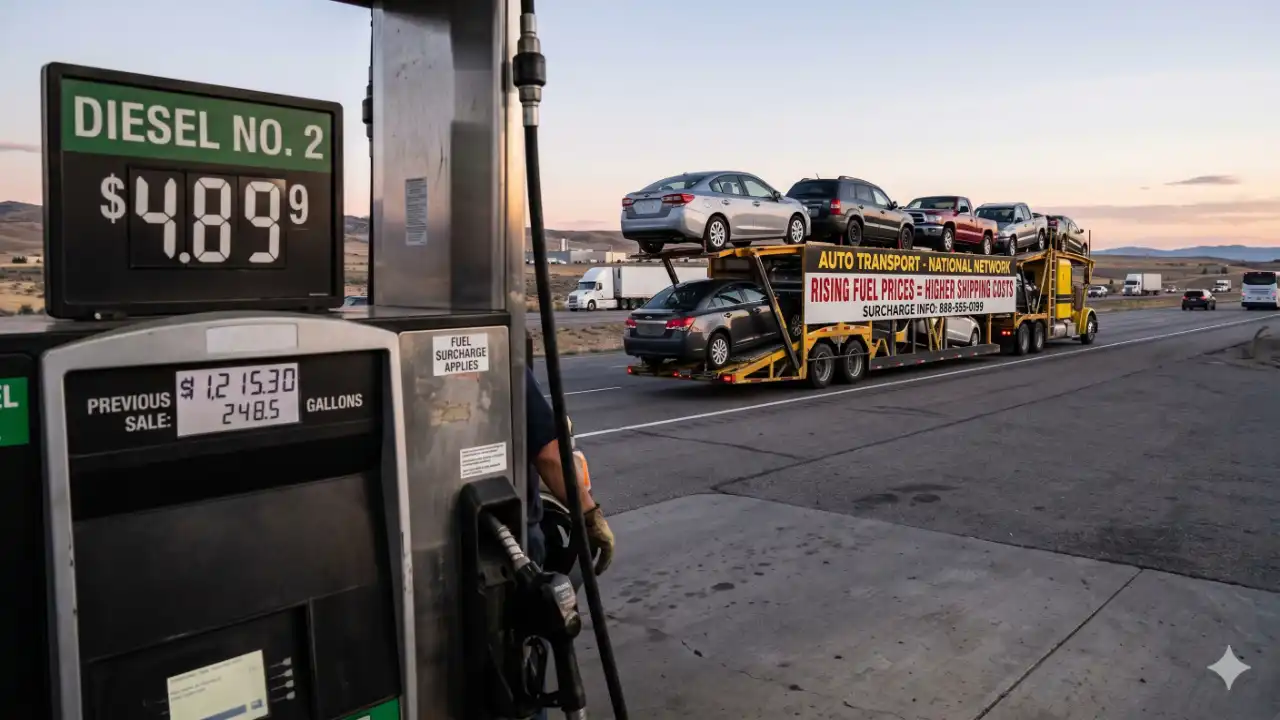
Why Diesel Prices Hit Auto Transport Harder Than Almost Any Other Industry
Every time diesel spikes at the pump, the auto transport industry feels it first. Carriers running open trailers and enclosed rigs don't get to pause and wait for prices to fall. They have vehicles to move, routes to cover, and drivers to pay — whether diesel is at $3.50 or $5.20 a gallon.
Auto transport costs are directly tied to diesel because every truck hauling your car runs on it. A single Class 8 hauler moving 8-10 vehicles gets roughly 6 to 7 miles per gallon fully loaded. On a 1,500-mile route from Chicago to Dallas, that truck burns through 215 to 250 gallons of diesel — one way. You start to see the math pretty quickly.
For customers trying to check current rates for your route, understanding the fuel piece of the puzzle can make the difference between sticker shock and a smart, timed decision.
Breaking Down the Fuel Surcharge on Auto Transport Quotes
Open your car shipping quote and you'll often see a line item called a fuel surcharge — or it's baked into the base rate without explanation. Either way, it's real, and it moves.
Most carriers and brokers tie their fuel surcharge to the U.S. Energy Information Administration (EIA) weekly diesel average. When the EIA number shifts, the surcharge table shifts with it. Here's how a typical surcharge table breaks down:
| EIA Weekly Diesel Average (per gallon) | Typical Fuel Surcharge % | Impact on a $900 Base Rate Quote |
|---|---|---|
| Under $3.50 | 10% – 14% | +$90 – $126 |
| $3.50 – $4.00 | 15% – 20% | +$135 – $180 |
| $4.00 – $4.50 | 21% – 27% | +$189 – $243 |
| $4.50 – $5.00 | 28% – 34% | +$252 – $306 |
| Over $5.00 | 35% + | +$315 or more |
This is why two identical quotes for the same car on the same route can differ by $150 or more depending on when you book. Timing your shipment is not just a scheduling issue — it's a pricing strategy.
Why Your SUV Costs $200 More Than a Sedan on I-95 During a Fuel Spike
Fuel surcharges aren't applied equally to every vehicle. Your carrier is thinking about deck space and weight, not just miles driven.
A compact sedan like a Honda Civic takes up one standard slot on a 10-car open carrier. A full-size SUV — say a Ford Expedition or Chevy Tahoe — may take one and a half slots due to height clearance on the upper deck. Some oversized SUVs and lifted trucks get forced to the lower deck, which limits how many other vehicles fit on the load.
During a diesel price surge on busy corridors like I-95 from New York to Miami or I-10 from Los Angeles to Houston, carriers get selective about their loads. They want maximum revenue per gallon burned. An oversized vehicle that reduces their payload efficiency costs the carrier more to haul — and they pass that on to you.
- Compact sedan (e.g., Toyota Corolla): $750 – $1,100 typical range during moderate fuel prices
- Mid-size SUV (e.g., Honda CR-V): $850 – $1,250 during same period
- Full-size SUV or truck (e.g., RAM 1500): $1,050 – $1,550 during same period
- Oversized lifted truck or large SUV (e.g., Chevy Tahoe, Escalade): $1,200 – $1,800+
During a fuel spike, add 15-25% across those ranges. That's where the $200 gap between a sedan and an SUV comes from — and it gets wider as diesel climbs.
The Routes Getting Hammered the Most Right Now
Not all routes feel fuel price pain the same way. Distance matters, but so does truck availability and regional supply chains.
The Northeast to Southeast corridor — particularly runs along I-95 from Boston and New York down to Florida — sees the sharpest surcharge spikes. Carriers battling New Jersey Turnpike tolls, Maryland's I-95 weigh station stops, and congested Atlanta interchanges burn more fuel per mile than on open-road routes.
The Midwest to California run along I-80 and I-40 is another pressure point. Empty miles matter here — westbound loads are often harder to fill than eastbound, so carriers building westbound runs face longer deadhead legs, burning fuel with no revenue attached.
Insider Tip: Southbound runs in October through December are peak snowbird season. Carriers fill fast on I-75 and I-95 heading to Florida. Paradoxically, this high-demand period can hold rates steadier — because full loads offset the per-unit fuel cost. Book early and you may dodge the worst surcharge pain.
For anyone shipping between specific states during high-diesel periods, check the Florida auto transport rates page or your specific corridor before locking in a price.
5 Dispatcher Tricks That Can Cut Your Transport Bill During a Fuel Spike
You can't control what diesel costs at the pump. But you can control several things that affect your final bill. These are moves real dispatchers use — and that smart customers can use too.
- Ship on a flexible date window. Carriers reward customers who give them 5-7 days of flexibility. That extra window lets them pair your car with a load that makes their fuel economics work. Tight pickup windows (24-48 hours) carry a premium, often $75-$150 more.
- Choose open carrier over enclosed. Open carriers haul 8-10 cars per load. Enclosed trailers haul 3-6. Open carriers spread fuel cost across more vehicles, so the per-car surcharge is lower. Unless you're shipping a classic, exotic, or brand-new luxury vehicle, open carrier almost always wins on price.
- Book a terminal-to-terminal route. Door-to-door service means the driver routes to your specific address, sometimes on surface streets. Terminal-to-terminal lets the driver stay on the Interstate, burning less fuel per mile. Savings range from $80-$175 on longer routes.
- Ship during shoulder season. February through April and September through October are typically lower-volume periods for auto transport. Fewer competing loads means carriers accept tighter margins — including smaller fuel surcharges — to fill their trucks.
- Get multiple quotes on the same day. Fuel surcharge tables reset weekly on the EIA cycle. Getting 3-5 quotes on the same day lets you compare base rates and surcharges from carriers using different table structures. The spread can be surprising.
What Open vs. Enclosed Carrier Fuel Economics Look Like in Practice
This is a question Car Shipping Hub gets constantly at the rate desk, so let's put real numbers on it.
An open 10-car hauler running from Dallas to Denver — roughly 1,000 miles on I-25 — burns about 160-175 gallons at current load weights. At $4.50 diesel, that's $720-$787 in fuel alone, split across 10 vehicles. Each vehicle's fuel allocation: $72-$79.
That same route in an enclosed 6-car trailer (heavier rig, lower MPG, higher insurance base) burns 190-210 gallons. At $4.50 diesel: $855-$945 total, split across 6 vehicles. Each vehicle's fuel allocation: $142-$157.
Before surcharges even hit, the enclosed option already costs twice as much per vehicle in fuel. Add surcharge percentages on top of a higher base rate, and enclosed car shipping during a diesel spike can run 60-80% more than open carrier for the same vehicle on the same route.
Red Flags in Quotes During High Fuel Periods — Don't Get Burned
When diesel prices jump, scam operators get active. They see stressed customers looking for relief on pricing, and they know exactly how to exploit that.
Watch for these specific tactics that spike during high fuel periods:
- The "no fuel surcharge" bait. A carrier quotes you $200 less than everyone else by advertising no fuel surcharge. Then, after they've accepted your deposit, a "fuel adjustment fee" appears at pickup. Always ask for an all-in price in writing before you pay anything.
- The deposit lock-in. A broker takes a $200-$400 deposit and gives you a "locked" rate. But the deposit is non-refundable — and their contract lets them adjust the final delivery price based on "market conditions." You're locked in; they're not.
- No MC number or DOT registration. Any legitimate carrier must have an active MC (Motor Carrier) number from the FMCSA. During fuel surges, unlicensed operators try to undercut licensed carriers. Check any carrier at safer.fmcsa.dot.gov before you pay.
Our team covers additional red flags in depth at the auto transport scam prevention guide. Read it before you sign anything during a high-fuel period when shady operators are most active.
How Car Shipping Hub and Furious Auto Shipping Protect You When Fuel Spikes
Car Shipping Hub works exclusively with vetted, licensed carriers. Every carrier in our network holds active MC and DOT credentials, verified insurance, and a clean safety rating. We check those credentials — not just at onboarding, but on an ongoing basis.
Our trusted partner Furious Auto Shipping operates a modern, well-maintained fleet specifically optimized for fuel efficiency on long-haul routes. Newer tractors running aerodynamic configurations burn 8-12% less diesel per mile than aging equipment — and those savings flow back into more stable, predictable quotes for customers.
During fuel spike periods, Car Shipping Hub's dispatching team actively monitors the EIA weekly diesel average and adjusts carrier matching to find routes and loads where the economics still work for customers. You won't always get the absolute lowest rate during a price surge — nobody can manufacture cheap diesel. But you will get a fair, transparent, all-in quote with no hidden "fuel adjustment" surprises at delivery.
You can see how the whole process works before you book at the how it works overview.
Frequently Asked Questions
How much does a fuel surcharge add to my car shipping quote right now?
Fuel surcharges currently range from 15% to 35% of the base rate, depending on the EIA weekly diesel average when you book. On a $950 base rate quote, that adds $142 to $332. Get a real-time quote from Car Shipping Hub to see the current all-in price for your specific route.
Do fuel prices affect car shipping the same on all routes?
No. Long-haul routes over 1,000 miles feel fuel spikes more sharply because carriers burn more absolute gallons. Shorter hauls under 500 miles have less exposure. High-traffic corridors like I-95 and I-10 also see compounded effects from tolls, weigh stations, and urban congestion that increase fuel burn per mile.
Is there a guaranteed way to lock in a car shipping price before fuel prices go higher?
Most reputable carriers and brokers allow you to book and lock a rate up to 2 weeks ahead of pickup. This protects you from surcharge table increases during that window. Avoid any contract that includes a "market adjustment" clause — that's a loophole to raise your price after you've paid a deposit.
Does open carrier or enclosed carrier handle fuel surcharges differently?
Open carriers spread fuel costs across 8-10 vehicles per load, so the per-car fuel surcharge is lower. Enclosed carriers haul fewer vehicles on a heavier rig, meaning each vehicle carries a larger share of the fuel cost. During a diesel spike, this gap widens — enclosed shipping can run 60-80% more than open on identical routes.
How do I know if a low quote during a fuel spike is legitimate?
Verify the carrier's MC number at safer.fmcsa.dot.gov. Ask for an all-in written quote with no "fuel adjustment" clauses. Avoid any company that asks for a large deposit before dispatching. If the quote is $300+ lower than every other offer during a high-fuel period, it almost always signals a bait-and-switch. Check our full red flag list before booking.
What is the cheapest time of year to ship a car given diesel price patterns?
February through early April typically offers the best combination of lower demand and more stable fuel prices. Avoid shipping in May-June (snowbird return surge northbound), October-December (southbound surge to Florida), and any period following a major refinery disruption or crude oil price jump.
Get a Transparent, All-In Quote — No Fuel Surprise at Delivery
Diesel prices change weekly. Your quote shouldn't be a mystery. Car Shipping Hub gives you a real, all-in price that includes the current fuel surcharge — no hidden adjustments, no bait-and-switch deposits, no fine print.
Our dispatching team monitors EIA diesel averages daily. We match you with vetted carriers running efficient equipment on routes where the numbers actually work for you.
Get Your Free Quote — takes 60 seconds, no commitment, and the price you see is the price you pay.