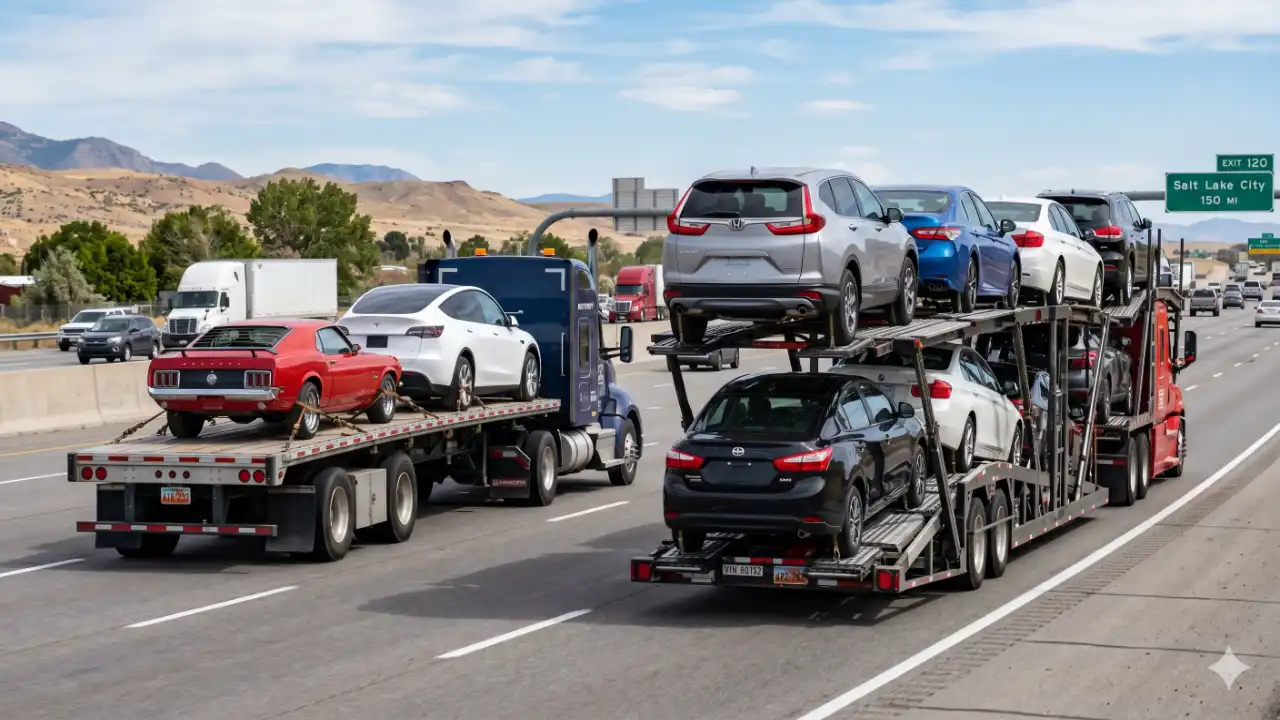
Most people booking auto transport think there's just one kind of truck: the big rig with cars stacked on it. But that's only half the picture. When you're shipping a vehicle, the trailer type matters just as much as the carrier's reputation. Get it wrong and you could be looking at loading damage, a sky-high invoice, or a driver who can't even reach your pickup address.
This guide breaks down the real difference between a flatbed vs. multi-car hauler, when each one makes sense, and how to avoid paying for the wrong setup. Whether you're moving a lifted truck, a low-riding sports car, or a fleet of sedans, there's a correct answer — and it's usually not what you'd guess.
What Exactly Is a Multi-Car Hauler?
A multi-car hauler is what most people picture when they think of car shipping. It's the large, two-deck trailer you see rolling down I-80 or I-10 with anywhere from 7 to 10 vehicles stacked on angled ramps. Carriers use hydraulic ramps to load vehicles on the upper and lower decks at specific angles.
This is the workhorse of the auto transport industry. It's efficient, cost-effective, and widely available on virtually every major corridor in the country. If your vehicle fits on the ramps and the driver can reach your address, a multi-car hauler is almost always the default choice.
There are two main varieties:
- Open multi-car hauler — No sides or roof. Vehicles are exposed to the elements. This is the most common type and the most affordable.
- Enclosed multi-car hauler — Fully enclosed trailer with walls and a roof. Used for exotic, classic, or high-value vehicles. Costs 30–50% more than open transport.
What Makes a Flatbed Trailer Different From the Rest?
A flatbed is exactly what it sounds like: a single, flat deck with no sides, no ramps, and no second level. The vehicle sits directly on the deck and is secured with straps, chains, or wheel cradles.
Flatbeds are common in freight hauling — think construction equipment, lumber, or industrial machinery. In the auto transport world, they serve a very specific purpose. They show up when a multi-car hauler simply can't do the job.
Here's why flatbeds matter for vehicle shipping:
- A vehicle can be driven, winched, or forklift-loaded onto the deck — no ramps required.
- They handle vehicles with extremely low or extremely high ground clearance.
- The single-deck design means no risk of fluids dripping from an upper-deck vehicle.
- Flatbeds can often access residential streets, farm roads, and tight lots that a 75-foot multi-car rig cannot navigate.
The tradeoff? You're paying for one vehicle on a trailer built for more. Flatbed rates for a single car typically run $1,100–$1,800 depending on the route, compared to $800–$1,350 for a standard multi-car slot.
The 6 Situations Where a Flatbed Beats a Multi-Car Hauler Every Time
This is where dispatchers earn their keep. Booking the wrong trailer isn't just an inconvenience — it can mean a driver shows up, can't load your vehicle, and charges a dry-run fee anyway. Here are the real scenarios where you need a flatbed.
1. Your Vehicle Has Less Than 4 Inches of Ground Clearance
Multi-car hauler ramps have a loading angle that varies by carrier, but most bottom out around 5–7 degrees. That's enough to scrape the nose of a lowered sports car, a widebody kit, or a custom bumper right off the vehicle.
If your car sits below 4 inches of ground clearance — think modified Subaru BRZ, slammed Dodge Charger, or any track-built car — a flatbed is not optional. It's the only safe option. The driver uses wheel cradles or a winch to load the car straight onto the flat deck without any nose-diving angle.
2. The Vehicle Doesn't Run or Can't Be Driven Onto a Ramp
A non-running vehicle (NRV) requires special handling. Most multi-car haulers can technically accept an NRV if the wheels roll freely, but loading it onto an angled ramp without engine power is risky. A flatbed with a winch setup makes this clean and controlled.
If the vehicle is wrecked, seized, or mechanically disabled, always request a flatbed with winch service. Expect to add $75–$150 in winch fees on top of the base rate.
Pro Tip from Dispatch: Always tell the carrier upfront if the vehicle is non-running. If a driver shows up expecting a running car and finds otherwise, they can legally refuse the load or charge a re-dispatch fee. Transparency saves everyone time and money.
3. The Vehicle Is Lifted More Than 7 Inches
This one surprises people. Lifted trucks and SUVs cause problems on multi-car haulers from the top, not the bottom. A lifted F-250 or Ram 2500 with a 6-inch suspension lift and 35-inch tires can exceed the upper-deck height limit on a standard hauler.
If the vehicle is too tall for the upper deck and too wide for the lower deck position, dispatchers have to either bump it to a flatbed or leave it behind. If you're shipping a heavily modified pickup, check your vehicle height before booking.
4. You Need Door-to-Door Delivery in a Tight Location
A 9-car hauler is roughly 75 feet long. That rig cannot navigate a narrow subdivision street, a mountain driveway, or a farm access road. When the driver can't get the big rig to your address, they arrange a terminal meet — you drive to a parking lot or truck stop to pick up.
A flatbed, usually hitched to a standard semi or a medium-duty truck, is far more maneuverable. If true door-to-door delivery matters to you and your location is tricky, a flatbed carrier is worth the extra cost.
5. You're Shipping a High-Value Classic on an Open Trailer
Enclosed multi-car haulers exist, but not every enclosed trailer is the right fit for a pristine 1967 Ford Mustang. Some enclosed multi-car rigs still use ramps, which means loading angle risk. A single-car enclosed flatbed — or a two-car stacker enclosed unit — keeps the vehicle level and isolated from any other cargo.
At enclosed auto transport price points, you're already investing in protection. Make sure the trailer matches the value of what you're shipping.
6. You're Moving Oversized or Modified Vehicles With Wide Bodies
Width restrictions on multi-car haulers typically cap around 102 inches. A vehicle with wide-body fender flares, extended mirrors, or commercial utility bodies can exceed that. A flatbed with proper oversize-load permitting handles these shipments legally and safely.
When a Multi-Car Hauler Is the Smarter Call
Flatbeds sound like the premium solution, but they're often overkill — and you'll pay for that overkill. Here's when to stick with the standard multi-car setup.
Standard Production Vehicles With Normal Ground Clearance
If you're shipping a Toyota Camry, Honda CR-V, or even a full-size pickup in stock form, a multi-car hauler handles it perfectly. These vehicles are designed to drive up ramps. There's zero risk in the loading process.
Budget-Conscious Shipping on High-Volume Routes
Routes like car shipping from New York to Florida or California to Texas see dozens of carriers running weekly. Multi-car hauler availability is high, which keeps rates competitive. On these corridors, a sedan ships for $750–$1,100 on an open multi-car unit. A flatbed on the same route would cost $400–$600 more with no real benefit for a standard vehicle.
When Speed Matters More Than Anything
Multi-car haulers dispatch faster on popular routes because carriers actively build full loads. A flatbed booking can sometimes take 3–5 days longer to dispatch because carriers need to justify the trip for a single vehicle. If you're on a tight timeline, the multi-car hauler wins.
Side-by-Side: Flatbed vs. Multi-Car Hauler at a Glance
| Factor | Flatbed | Multi-Car Hauler (Open) | Multi-Car Hauler (Enclosed) |
|---|---|---|---|
| Average Cost (Mid-Range Route) | $1,100–$1,800 | $750–$1,350 | $1,100–$1,900 |
| Vehicles per Load | 1–2 | 7–10 | 2–6 |
| Ground Clearance Minimum | None (winch available) | ~4 inches | ~3 inches (enclosed ramps) |
| Non-Running Vehicles | Yes (winch service) | Possible (limited) | Possible (limited) |
| Door-to-Door in Tight Locations | More likely | Less likely | Less likely |
| Exposure to Weather | Full exposure | Full exposure | Fully protected |
| Dispatch Speed (Popular Routes) | Slower (3–7 days) | Faster (1–3 days) | Moderate (2–5 days) |
| Best For | Modified, NRV, oversized | Standard daily drivers | Classics, exotics, luxury |
What Dispatchers Look at When They Assign Your Trailer
When you submit a shipping request, a dispatcher — not an algorithm — typically reviews your vehicle specs and pickup location before assigning a trailer type. Here's what they check:
- Vehicle height and ground clearance — pulled from your VIN or specs you provide.
- Running condition — running vehicles load faster and cost less.
- Pickup and delivery addresses — rural routes, gated communities, and mountain access roads often eliminate multi-car haulers immediately.
- Declared value and insurance requirements — higher declared values may trigger an enclosed recommendation regardless of vehicle type.
- Route volume — low-volume routes (think rural Montana to rural Mississippi) may default to flatbed because multi-car loads are hard to fill.
At Car Shipping Hub, our dispatch team reviews every order manually before assigning a carrier. That's how we catch mismatches before a driver shows up with the wrong rig. You can learn how the process works from quote to delivery on our site.
The Cost Math: Is a Flatbed Ever Worth the Premium?
Let's run the numbers honestly. Say you're shipping a lowered Porsche 911 from Atlanta, GA to Dallas, TX — roughly 780 miles.
On an open multi-car hauler, that route might quote at $950–$1,150. But with a lowered vehicle, the driver may not be able to load it safely. If they try and scrape a lip spoiler, you're looking at a body repair bill of $600–$1,500 — potentially more than the shipping cost itself.
On a flatbed with wheel cradles, the same route costs $1,300–$1,600. The premium is real. But it's cheaper than a repair claim, a dispute with the carrier's insurance, and weeks of waiting for body shop availability.
Our partner Furious Auto Shipping handles a high volume of modified vehicle transport and consistently recommends the flatbed route for anything with aftermarket suspension or body kits. Their drivers are trained specifically for non-standard load setups.
Use Car Shipping Hub's cost calculator to compare open, enclosed, and flatbed estimates side by side for your specific route and vehicle.
Frequently Asked Questions
Can any car be shipped on a flatbed trailer?
Yes. A flatbed can handle virtually any vehicle — running or non-running, stock or modified, standard height or lifted. If the vehicle has wheels, a flatbed with a winch can load it. There are no real exclusions, only cost considerations.
How much more does a flatbed cost compared to a standard multi-car hauler?
Expect to pay $300 to $600 more for a flatbed on most mid-range routes. On shorter runs under 500 miles, the premium may be less. On long hauls like coast-to-coast, the gap can reach $700 or more depending on carrier availability.
Will my car be exposed to weather on a flatbed?
Yes. A standard flatbed is open to the elements just like an open multi-car hauler. If weather protection matters, ask about enclosed flatbed options or single-car enclosed trailers. Car Shipping Hub can connect you with enclosed flatbed carriers for high-value vehicles.
How long does it take to dispatch a flatbed vs. a multi-car hauler?
On busy corridors like I-95 or I-75, a multi-car slot can dispatch in 1 to 3 business days. A flatbed for a single vehicle may take 3 to 7 days because carriers need to justify the run. Rural routes on either trailer type can take longer.
Can a multi-car hauler pick up from my house?
It depends entirely on your street and neighborhood layout. A 75-foot rig needs wide turns and clearance. Many residential areas require a terminal meet at a nearby parking lot. A flatbed hitched to a shorter cab is often more maneuverable for tight addresses.
Does Car Shipping Hub offer both flatbed and multi-car hauler options?
Yes. Car Shipping Hub works with a vetted network of carriers offering open multi-car, enclosed multi-car, and flatbed transport. Our team matches your vehicle specs and location to the right trailer type automatically. Get a free quote to see all available options for your route.
Ready to Ship? Get the Right Trailer for Your Vehicle
Choosing between a flatbed and a multi-car hauler isn't complicated once you know the rules. Standard vehicle with normal clearance? Go multi-car and save money. Lowered, lifted, non-running, or oversized? A flatbed protects both your vehicle and your wallet in the long run.
Car Shipping Hub makes it easy to book the right setup from day one. Our dispatch team reviews your vehicle specs manually, matches you to the correct carrier, and gives you a transparent quote with no surprise fees at delivery.
Get Your Free Quote — takes about 90 seconds and you'll have options waiting in your inbox.