The $400 Question Most Shippers Get Wrong
Every week, someone calls our dispatch team asking the same thing: "Is enclosed shipping really worth the extra money?" The honest answer is — it depends entirely on what you're shipping and where it's going.
The gap between open carrier vs. enclosed carrier pricing is real. On a mid-distance route like Chicago to Dallas, that difference can run anywhere from $300 to $600 extra for enclosed. On a cross-country haul from Seattle to Miami, you might be looking at $800 to $1,200 more.
That's not a rounding error. That's a real decision. And most shippers make it without the right data.
In this guide, we're going to lay it all out — trailer types, price tiers, vehicle eligibility, and the situations where paying more actually makes sense. Learn how the full shipping process works if you're new to auto transport, then come back here to nail down the right carrier choice.
What Open Carrier Transport Actually Looks Like on the Road
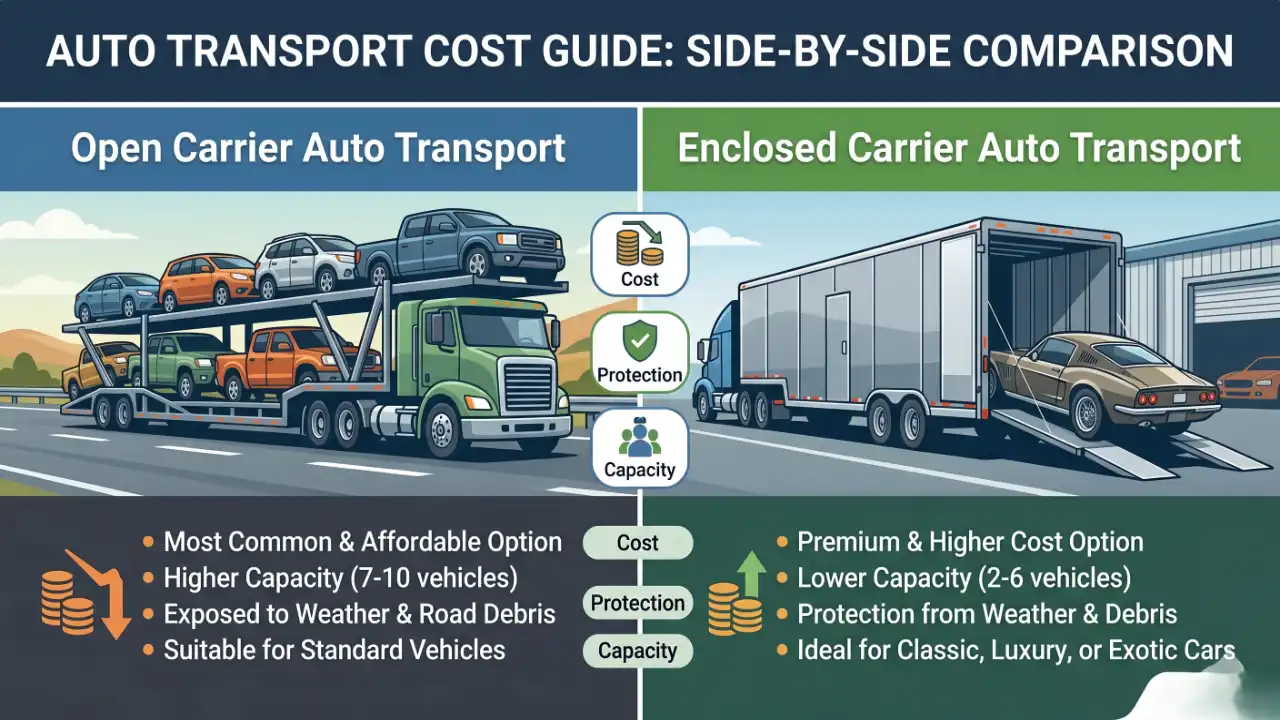
Picture the car hauler you pass on I-80 near Gary, Indiana — stacked two levels high, nine or ten vehicles chained in at various angles. That's an open carrier. It's the workhorse of the auto transport world.
Open trailers run on every major corridor in the country. Drivers dispatch daily out of hubs like Atlanta, Dallas, Los Angeles, and Chicago. Because demand is high and capacity is plentiful, you get faster pickup windows and lower rates.
The tradeoff is exposure. Your car rides in open air. It gets road debris, rain, dust, and whatever the weather throws at it between pickup and drop-off. For most standard vehicles, that's completely fine. Dealerships ship new cars this way every single day.
Dispatcher's Take: If your car drives on a rainy day without you worrying about it, an open carrier is almost certainly the right call. Save the budget for something else.
What Enclosed Carrier Transport Gets You That Open Never Will
Enclosed trailers are fully covered — either hard-sided or soft-sided — and load vehicles differently. Many use hydraulic lift gates instead of ramps, which means zero ground clearance issues for exotic or lowered cars.
Capacity is smaller. Most enclosed trailers haul two to six vehicles at a time versus the nine or ten on an open rig. That smaller load means the carrier can give each car more attention at pickup and delivery.
Enclosed also means full weather protection. No road salt off I-90 in February. No construction grit flying off a dump truck on I-95 near Baltimore. No UV exposure on a three-day run through the Arizona desert.
For a Ferrari, a show-ready classic, or a brand-new Porsche still in factory wrap, that protection matters. For a 2019 Honda Accord with 60,000 miles on it — probably not worth the premium.
The Side-by-Side Cost Breakdown by Route Distance
Here's where the numbers get real. These figures reflect typical 2025 market rates. Actual quotes vary based on vehicle size, trailer availability, and seasonal demand spikes.
| Route Distance | Open Carrier (Sedan) | Enclosed Carrier (Sedan) | Price Difference | % Premium |
|---|---|---|---|---|
| Under 500 miles | $350 – $550 | $650 – $900 | +$300 – $350 | ~60–75% |
| 500 – 1,000 miles | $600 – $850 | $950 – $1,300 | +$350 – $450 | ~55–65% |
| 1,000 – 1,500 miles | $800 – $1,100 | $1,300 – $1,800 | +$500 – $700 | ~55–70% |
| 1,500 – 2,500 miles | $1,000 – $1,400 | $1,800 – $2,600 | +$800 – $1,200 | ~70–90% |
| Cross-Country (2,500+ miles) | $1,100 – $1,600 | $2,000 – $3,000 | +$900 – $1,400 | ~80–100% |
Notice that the percentage premium stays roughly 55–100% higher for enclosed across every distance tier. The dollar gap widens on longer routes because enclosed carriers have fewer runs available and drivers charge more for coast-to-coast enclosed hauls.
Want to see what your specific route looks like right now? Car Shipping Hub's cost calculator gives you a live estimate in under 60 seconds.
5 Hidden Factors That Shift the Price Gap Wider (Or Narrower)
The table above is a starting point, not a guarantee. Several real-world variables push rates in either direction — and knowing them before you book saves money.
- Vehicle Size: Trucks, SUVs, and full-size vans cost 15–30% more than sedans on both carrier types. On an open trailer, a RAM 2500 takes up a full slot that could hold a compact car. On enclosed, a large SUV may only allow four vehicles total on the trailer instead of six.
- Seasonal Demand Spikes: Snowbird season (October through December southbound on I-75 and I-95) and the spring return (April through June northbound) create real bottlenecks. Open carrier rates in these corridors jump $100–$250. Enclosed rates spike even harder because far fewer enclosed rigs run those routes.
- Pickup Location: Rural pickups cost more. A carrier will happily grab your car off I-10 in Houston. Getting one to drive 45 miles off the main corridor to Kerrville, Texas adds a fuel premium — often $75–$150 extra on top of base rate.
- Inoperable Vehicles: If your car doesn't run, both carrier types charge a winch fee — typically $100–$200 extra — because the driver can't drive it onto the trailer.
- Terminal vs. Door-to-Door: Using a terminal (dropping your car at a holding yard and picking it up at another) saves $50–$150 compared to door-to-door. This option is more widely available on open carrier routes.
Which Vehicles Actually Need Enclosed Shipping
This is where a lot of shippers waste money — or worse, underspend on a car that genuinely needed the protection. Here's a practical breakdown by vehicle type.
Vehicles That Almost Always Warrant Enclosed
- Exotic and Supercar: Ferrari, Lamborghini, McLaren, Bugatti. These cars have extreme low clearance and paint that costs thousands to repair. Open carrier is a liability on a $300,000 car.
- Classic and Vintage Cars: Pre-1980 vehicles with original paint jobs, chrome trim, or convertible tops benefit greatly from weather protection. A single hailstorm mid-transit can wipe out years of restoration work.
- Concours-Condition Show Cars: If a car has been detailed to show standards, open carrier road grime is a genuine problem — even with plastic covers.
- Brand-New Luxury Vehicles: A new Bentley, Rolls-Royce, or AMG GT still under factory wrap often ships enclosed as a manufacturer or dealer requirement.
- High-Value Modified Vehicles: Custom builds with expensive paint, body kits, or aftermarket wheels that aren't factory replaceable.
Vehicles That Ship Just Fine on Open Carriers
- Daily drivers of any make and model
- Used vehicles under $30,000 in value
- Dealership inventory (new cars included)
- Pickup trucks and standard SUVs
- Military POVs (personally owned vehicles) during PCS moves
- Student vehicles during semester transitions
Industry Insider: The breakpoint most dispatchers use is roughly $50,000 vehicle value. Below that, open carrier insurance coverage is almost always sufficient. Above it, the math on enclosed starts to make sense.
How Carrier Insurance Differs — And Why It Matters More Than You Think
Open and enclosed carriers both carry cargo insurance. But the structure of that coverage differs in ways that affect you directly.
Standard open carrier cargo policies run $100,000 to $250,000 per load. With nine vehicles on the trailer, that coverage spreads thin if multiple cars sustain damage in an accident.
Enclosed carriers typically carry higher per-vehicle limits — often $500,000 to $1,000,000 per load with fewer vehicles on board. Some enclosed operators carry agreed-value policies for high-value cars, which means no depreciation disputes at claim time.
Before booking either carrier type, always ask for the carrier's Certificate of Insurance (COI). Verify their MC number through the FMCSA's SAFER system at safer.fmcsa.dot.gov. Any carrier that hesitates to share that information is a carrier you should walk away from.
Our partners at Furious Auto Shipping carry full cargo coverage on every load and will provide documentation before your car ever leaves the driveway.
The Real Decision Framework: 3 Questions to Ask Yourself
Skip the guesswork. Answer these three questions and the right carrier type usually becomes obvious.
- Is your vehicle worth more than $50,000 — or irreplaceable? If yes, enclosed is worth the premium. If no, open carrier is your friend.
- Are you shipping through a high-weather corridor in a bad season? I-80 through the Rockies in January, I-90 through the Upper Midwest in November — if your route runs through winter weather zones during bad months, enclosed adds real peace of mind for vulnerable vehicles.
- Do you have a hard delivery deadline? Enclosed carriers run less frequently on most routes. If you need a car moved in under 10 days, open carrier availability is significantly better in most markets.
Car Shipping Hub's dispatch team walks through exactly this framework on every quote call. We don't upsell you into enclosed if your car doesn't need it. And we won't undersell you into open if it does.
Ready to see real numbers for your specific vehicle and route? Get your free quote now — no commitment required.
What the Bill of Lading Tells You About Carrier Accountability
Regardless of which carrier type you choose, the Bill of Lading (BOL) is your most important document. Think of it as the condition report and legal receipt for your vehicle.
At pickup, the driver and you both inspect the car together. Every scratch, ding, and paint chip gets noted on the BOL. Both parties sign it. At delivery, you do the same inspection and compare to the original BOL.
If new damage appears that wasn't on the original BOL, that's your evidence for a claim. Take timestamped photos at both pickup and delivery — even if the driver seems trustworthy. This protects you on both open and enclosed shipments.
Enclosed carriers tend to be more meticulous about BOL documentation because their clients are more likely to file claims on high-value vehicles. But the process is identical regardless of trailer type.
For a full walkthrough of what to expect from quote to delivery, read our step-by-step shipping process guide — it covers every checkpoint along the way.
Frequently Asked Questions
How much more does enclosed car shipping cost compared to open carrier?
Enclosed carrier shipping typically costs 55–100% more than open carrier on the same route. On a 1,500-mile haul, expect to pay roughly $500–$800 more for enclosed. Exact pricing depends on vehicle size, route, and seasonal demand.
Is open carrier shipping safe for a brand-new car?
Yes. Dealerships across the country ship new vehicles on open carriers every day. Open transport is industry-standard. The exposure risk is minimal for most vehicles, and carrier cargo insurance covers damage caused during transit.
How long does enclosed car shipping take compared to open?
Transit times are similar — roughly 400–500 miles per day on both carrier types. However, enclosed carriers have fewer trucks running most routes, so pickup wait times can be 3–7 days longer than open carrier availability on the same corridor.
Can Car Shipping Hub arrange both open and enclosed transport?
Yes. Car Shipping Hub works with vetted carriers for both trailer types on routes across all 50 states. Our team matches your vehicle and budget to the right option and handles all the carrier coordination for you.
What vehicle types require enclosed shipping?
Enclosed shipping is strongly recommended for exotics, classics, concours show cars, and vehicles valued above $50,000. Everyday vehicles — sedans, trucks, standard SUVs — ship safely and affordably on open carriers in almost all cases.
Does enclosed shipping have better insurance coverage?
Generally yes. Enclosed carriers typically carry higher per-load cargo coverage and sometimes offer agreed-value policies for high-value vehicles. Always request a Certificate of Insurance from any carrier before you book, regardless of trailer type.
The Bottom Line: Pick the Carrier That Fits the Car
The right answer isn't always the cheaper one. But it's also not always the more expensive one. Open carriers move the vast majority of vehicles in the US safely, on time, and at a fraction of the cost of enclosed.
If your car is a daily driver, a used vehicle, or anything under $50,000 in value — open carrier is the smart, practical choice. If you're moving a collector piece, an exotic, or a show car you've spent years building — enclosed isn't a luxury. It's basic protection.
At Car Shipping Hub, we'll give you straight talk on which option makes sense for your specific situation. No pressure. No upsells. Just honest dispatch advice backed by 35+ years in the industry.
Get your free quote now and see exactly what open vs. enclosed costs for your route — live rates, no commitment required.