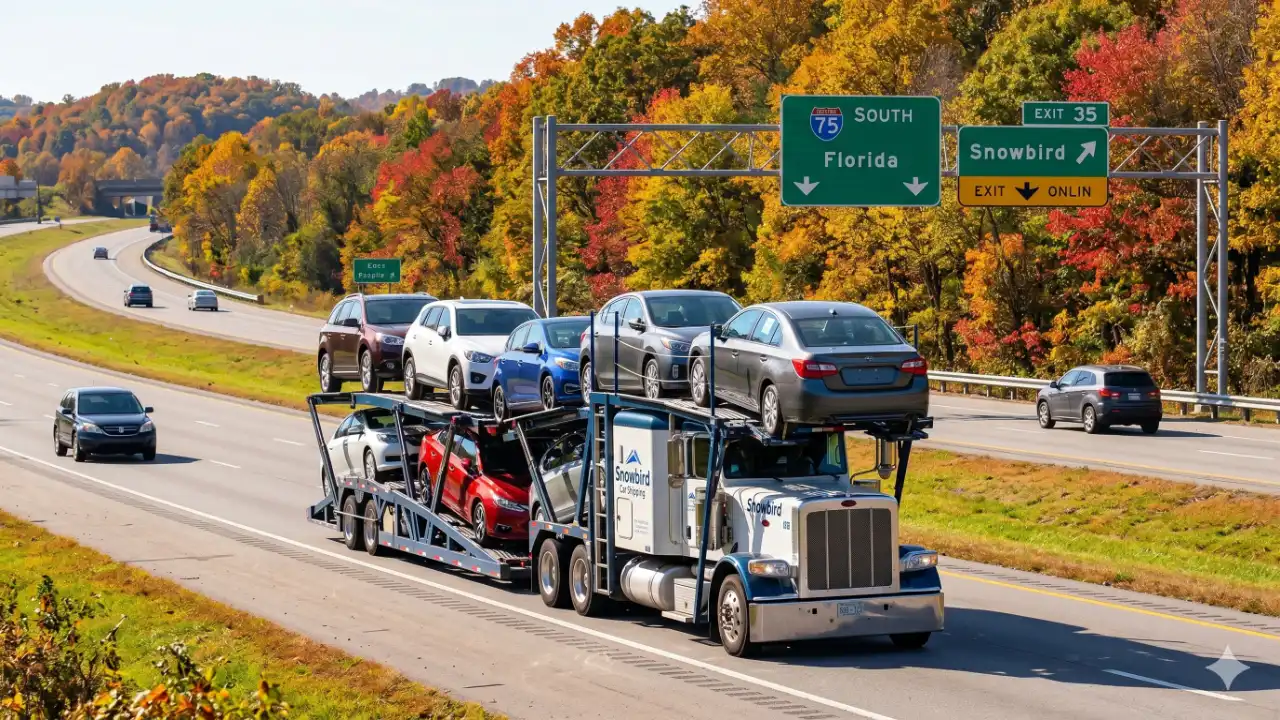
Every year, the same thing happens. Millions of retirees and part-time residents start making plans to head south for the winter — and then about six weeks later, they all try to ship their cars at the exact same time. If you've ever wondered why snowbird car shipping seems to cost more in October than it did in May, that's your answer right there. Supply tightens. Demand spikes. Prices climb fast.
After 35 years of dispatching vehicles along these seasonal corridors, I can tell you this: the snowbirds who get the best deals and the smoothest deliveries are the ones who plan ahead. This guide covers exactly what you need to know — including the weeks you must avoid, the routes that get hit hardest, and the insider moves that can cut your bill by a couple hundred dollars.
Why Snowbird Car Shipping Demand Explodes in Fall
The snowbird migration isn't random. It follows a predictable pattern that the trucking industry tracks closely. Most seasonal residents start their southbound moves between mid-October and late November. The Thanksgiving window — roughly the two weeks before the holiday — is the single most congested shipping period of the entire year on southbound lanes.
Here's what that means for you as a shipper. Every open carrier heading down I-75, I-95, and I-10 fills up fast. Carriers get to be selective. They raise rates, take only the easiest pickup locations, and sometimes skip rural stops altogether. A sedan that cost $900 to ship from Ohio to Fort Myers in July might run $1,150 or more by mid-October.
The spike isn't just about Florida. Arizona and the I-10 corridor see the same surge. Snowbirds heading to Scottsdale, Mesa, Tucson, and the Yuma area create a parallel crunch on routes from Illinois, Colorado, and the Pacific Northwest.
The Exact Routes That Get Slammed Every October
Not all routes feel the crunch equally. Some corridors get hit so hard that carriers go weeks without available slots. These are the routes where you need to book the earliest.
- I-95 Northbound pickup to South Florida: New York, New Jersey, Connecticut, and Massachusetts residents flood this route. Miami, Fort Lauderdale, and Boca Raton are the top drop points.
- I-75 Southbound from the Midwest: Ohio, Michigan, Indiana, and Kentucky snowbirds flock toward Naples, Sarasota, Fort Myers, and Tampa. This is the most congested single corridor in the country during peak season.
- I-10 West from Texas into Arizona: Houston and Dallas snowbirds heading to the Valley of the Sun create a steady surge from September through November.
- I-65 and I-85 into the Florida Panhandle: Snowbirds from Tennessee, Alabama, and Georgia often target Destin, Pensacola, and Panama City Beach.
If your pickup is anywhere along these corridors, expect 5-10 days longer transit windows and 15-25% higher rates compared to the spring return season. That's just the reality of peak demand.
Book 3-4 Weeks Out — Or Pay the Spike Price
This is the single most important piece of advice I can give you. Book your snowbird car shipping 3 to 4 weeks before your target pickup date. Most people wait until 7 to 10 days out. By then, they're paying premium rates for whatever carrier slots remain.
Booking early does two things for you. First, it locks in a rate before demand drives it up. Second, it gives dispatchers enough time to match your vehicle with a carrier doing a full trailer run on your route — which means a smoother, faster delivery instead of a patchwork multi-carrier handoff.
Pro Tip from Dispatch: If you're flexible on your pickup date by 2-3 days in either direction, tell your broker upfront. That flexibility is worth real money. Carriers prefer predictable loading windows, and they'll often take a slightly lower rate to fill a slot on a confirmed departure day.
At Car Shipping Hub, we start seeing the seasonal rate jump in late September. Customers who book in early October consistently pay less than customers who wait until the week they need to leave. The math is simple — check current rates for your route before the crunch hits.
Open Carrier vs. Enclosed: Which One Makes Sense for Your Snowbird Move
Most snowbirds ship on open carriers and that's the right call for the majority of vehicles. Open transport runs $850 to $1,350 for a standard sedan on most major snowbird routes. It's reliable, widely available, and gets the job done.
Enclosed transport is a different story. It's the right choice for luxury vehicles, classics, low-clearance sports cars, or anything with a value over $60,000. You're looking at $1,400 to $2,200+ for the same routes — but your vehicle rides inside a sealed trailer, shielded from road debris, weather, and exposure.
| Vehicle Type | Recommended Transport | Typical Snowbird Season Rate | Transit Time (FL Routes) |
|---|---|---|---|
| Standard Sedan (Camry, Accord) | Open Carrier | $900 – $1,150 | 5–8 days |
| Full-Size SUV (Tahoe, Expedition) | Open Carrier | $1,050 – $1,350 | 5–8 days |
| Pickup Truck (F-150, Ram 1500) | Open Carrier | $1,000 – $1,300 | 5–8 days |
| Luxury Sedan (BMW 7, Mercedes S) | Enclosed Recommended | $1,500 – $1,900 | 6–9 days |
| Classic or Exotic Vehicle | Enclosed Only | $1,700 – $2,400+ | 7–12 days |
One thing that catches snowbirds off guard: oversized vehicle surcharges. If you're driving a dually pickup, a lifted truck, or a large diesel SUV with a roof rack, expect a $100 to $300 surcharge on top of the base rate. Carriers price by size and weight because bigger vehicles take up more trailer space and burn more fuel.
The 5-Step Pre-Shipment Checklist Every Snowbird Needs
Getting your car ready before the carrier arrives saves you delays and avoids disputes at delivery. Follow these steps every time.
- Take a full photo inspection. Walk around the entire vehicle and photograph every panel, all four corners, the roof, and the interior. Timestamp your photos. This is your proof against any pre-existing damage claims.
- Fuel down to a quarter tank. Carriers don't want full tanks. Gas adds weight. Most carriers require your tank to be at or below 25% before loading.
- Remove personal items. Anything left inside your vehicle is not covered by carrier insurance — period. Clear out laptops, sunglasses, toll tags, and anything of value. A few personal items under 100 lbs is generally tolerated, but don't push it.
- Disable your car alarm. An alarm that triggers mid-transport is a nightmare for drivers. Disable it or leave a spare key fob with clear instructions.
- Review your Bill of Lading at pickup. The driver will inspect the car with you and mark any existing damage. Don't let the driver rush this step. Read every mark before you sign. The Bill of Lading is your legal protection document.
For a complete walkthrough of the full shipping process from booking to delivery, check out how Car Shipping Hub handles your move end-to-end.
Why Your Arizona Snowbird Route Costs Less Than Florida
Many snowbirds heading to Scottsdale, Chandler, or Sun City are surprised to find their quotes run $100 to $200 cheaper than Florida routes for similar distances. The reason is carrier density and return load availability.
Florida is a peninsula. Carriers drive down and have to drive back up mostly empty. Arizona sits on a cross-country corridor — I-10 — where carriers regularly pick up return loads heading west. That balance keeps rates slightly lower. The tradeoff is transit time. Arizona routes from the Midwest can take 7 to 11 days depending on the pickup state and the carrier's route sequence.
For routes like Chicago to Phoenix or Denver to Scottsdale, expect rates in the $850 to $1,150 range during peak snowbird season. For Florida routes of similar length — say, Cincinnati to Fort Myers — budget closer to $1,000 to $1,350.
You can run your specific route through Car Shipping Hub's cost calculator to see current pricing before you commit to anything.
Red Flags to Watch for During Snowbird Season
Peak season brings out bad actors. Demand is high and some outfits exploit confused first-time shippers. Here's what to watch for.
- Bait-and-switch quotes: A broker gives you an impossibly low quote, collects a deposit, and then calls you a week before pickup to say the rate went up. If a quote is more than 20% below other estimates, it's almost certainly a bait-and-switch setup.
- No MC number or FMCSA registration: Every legitimate carrier must be registered with the Federal Motor Carrier Safety Administration. Search any carrier's name at FMCSA.dot.gov before you book. No registration means no legitimate operation.
- Cash-only deposits with no receipt: Reputable brokers accept credit cards and provide written confirmation. Anyone demanding a wire transfer or cash-only deposit is a major red flag.
- Vague delivery windows: "We'll call you 24 hours before delivery" is fine. "Delivery could be anywhere from 5 to 30 days" is not. Get a realistic window in writing before you pay anything.
For a deeper look at how these scams work and how to protect yourself, we've put together a full resource on the most common auto transport scams and how to spot them early.
The Spring Return: Don't Forget to Plan the Northbound Trip
Most snowbirds think about the fall shipment and forget to plan the spring return. That's a mistake. The northbound surge from Florida and Arizona hits hard in April and May. Carriers that were packed heading south are now in high demand heading north.
The good news: spring rates are slightly lower than fall rates on most Florida routes. Carriers are eager to move northbound to rebalance their fleets. But the window is just as tight. April 1 to May 15 is the peak return period. Book your northbound transport 3 to 4 weeks out, same as the fall move.
If you're a dual-vehicle household — two cars, one couple — consider staggering your shipments. Ship one car in each direction, or ship one and drive the other. It spreads your cost and gives you more flexibility if delivery windows shift.
Car Shipping Hub, working alongside our trusted partner Furious Auto Shipping, coordinates both legs for many of our seasonal customers. It simplifies scheduling and ensures both shipments get the same level of tracking and communication.
Frequently Asked Questions
How far in advance should I book snowbird car shipping?
Book 3 to 4 weeks before your target pickup date. This is the sweet spot for getting solid carrier matches without paying last-minute premium rates. Waiting until 7 to 10 days out during peak season almost always means higher costs and longer waits.
What does snowbird car shipping typically cost from the Midwest to Florida?
Expect $950 to $1,350 for a standard sedan during peak fall season. Larger vehicles like SUVs and pickups run $1,050 to $1,400. Enclosed transport for luxury or classic cars runs $1,500 to $2,200+ on most Midwest-to-Florida routes.
Can I put personal items in my car during transport?
Most carriers allow a small amount of personal items under 100 pounds in the trunk. However, those items are not covered by carrier insurance. Never leave anything of high value inside the vehicle. The carrier's liability only covers the vehicle itself.
How long does car shipping to Florida take during snowbird season?
Plan for 5 to 9 days on most routes during peak season. High demand means fuller trailer runs and slightly longer scheduling windows. If you need your vehicle by a specific date, add 2 to 3 extra days as a buffer when you book.
How do I know if a carrier is legitimate?
Look up any carrier or broker on FMCSA.dot.gov using their MC number. A valid, active registration is the baseline requirement. Car Shipping Hub only works with vetted, FMCSA-registered carriers — you can review our vetting process on our about page.
Does Car Shipping Hub handle both the fall southbound and spring northbound moves?
Yes. Many of our seasonal customers book both legs at once. It locks in priority dispatch for both directions and gives you a dedicated point of contact for the whole season. Contact us to set up both shipments together.
Ready to Lock In Your Rate Before the Season Crunch?
The carriers filling up right now. Every week you wait, the available slots shrink and the rates climb. Don't let the fall surge catch you off guard — take 60 seconds and get your personalized quote today.
Car Shipping Hub has handled thousands of snowbird moves along every major seasonal corridor. We know the routes, we know the timing, and we know how to get your vehicle delivered without the drama.
Get Your Free Quote — see your exact rate in seconds, no obligation required.