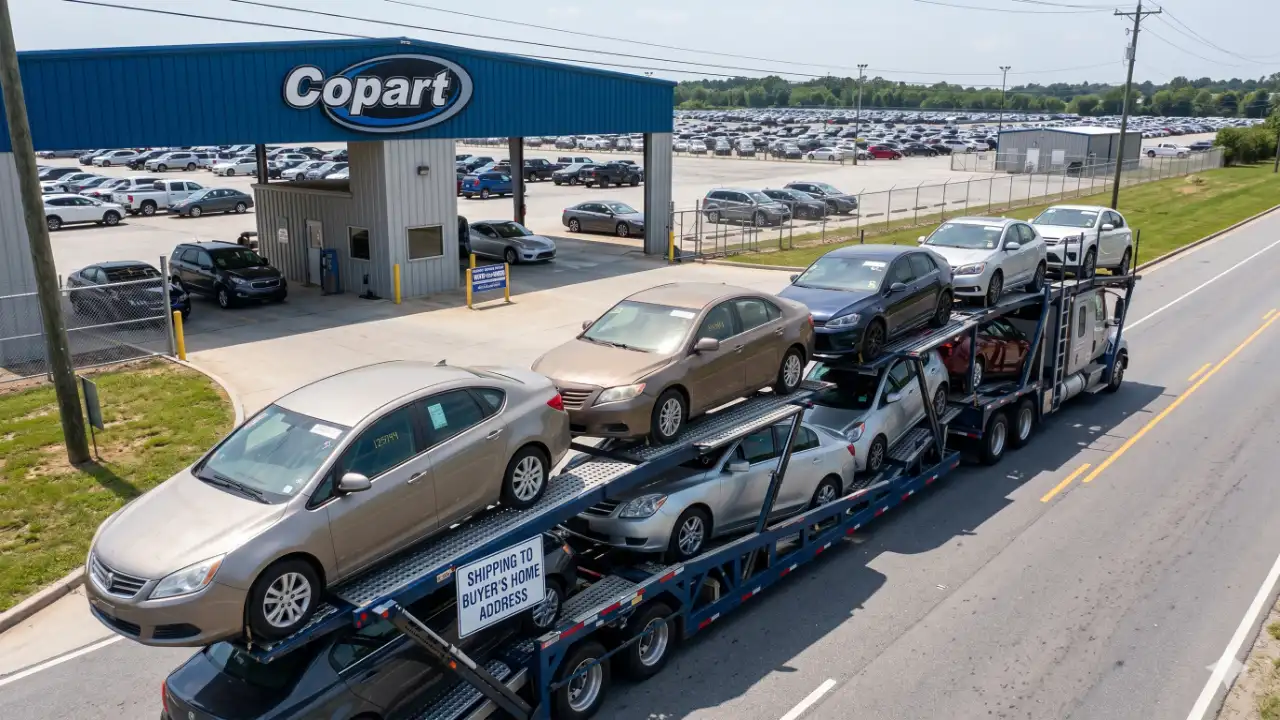
So you won the bid. Congratulations. Now what?
Whether you snagged a clean-title daily driver on Copart, a repairable wreck on IAAI, or a dealer-grade fleet unit on Manheim, you've got one immediate problem — the car is sitting in a storage yard hundreds of miles away, and the clock is already ticking on storage fees.
This guide covers how to ship a car from auction step by step. We'll walk through title release, carrier booking, what happens at pickup, and how much you should realistically expect to pay. No fluff — just the stuff that actually matters.
Why Auction Shipping Is Different From a Standard Move
Shipping a car from Copart or IAAI isn't the same as shipping a running vehicle from a private seller. There are three major differences you need to understand before you book anything.
- Storage fees start immediately. Most auction yards give you 3-5 free days after payment clears. After that, fees run $20–$50 per day depending on the location.
- Gate access requires documentation. Carriers can't just roll up and grab your vehicle. They need a Gate Release or a Buyer's Authorization Form — specific to each auction house — before the yard staff will release the car.
- Non-running vehicles need special equipment. If the car doesn't start or roll, your carrier needs a winch truck. That adds $75–$150 to your transport bill and narrows your carrier options significantly.
Insider Tip: Call the specific auction yard — not just the main auction hotline — as soon as your payment clears. Ask them directly: "What do I need to submit for a carrier gate release?" Each yard has its own process, and some require 24-48 hours to process the authorization before a carrier can show up.
How Each Auction House Handles Carrier Pickup
The three major auction platforms each have slightly different pickup protocols. Here's what to expect at each one.
| Auction House | Gate Release Process | Non-Running Vehicle Protocol | Typical Free Storage Window | After-Hours Pickup? |
|---|---|---|---|---|
| Copart | Carrier submits MC number + buyer authorization via Copart's online gate release system | Winch service available on-site at most locations for a fee (~$150-$250) | 3 business days after payment | No — M-F, business hours only at most yards |
| IAAI (Insurance Auto Auctions) | Buyer submits a "Third-Party Authorization" form; carrier must have valid MC and DOT numbers on file | Carrier must bring own winch or flatbed; IAAI does not provide loading assistance | 3-5 business days after title/payment clears | Limited — call your specific yard |
| Manheim | Dealer-to-carrier release via Manheim's transport portal or direct yard contact; floor plan buyers may need additional docs | Most Manheim vehicles are running; if not, carrier coordination required | 3-5 business days; varies by location | Some locations — verify with your yard |
The Step-by-Step Process to Get Your Auction Win Transported
Here's the exact sequence to follow after your payment clears. Do these in order and you'll avoid the most common delays.
- Confirm payment and title status. Your carrier cannot legally pick up the vehicle until the auction house confirms your payment is fully cleared. For salvage titles, this can take 5-10 business days. For clean titles, it's usually 1-3 days.
- Get the gate release authorization ready. Log into your Copart, IAAI, or Manheim account and locate the buyer authorization or gate release form. Fill it out with your carrier's MC number and DOT number. Submit it at least 24-48 hours before your desired pickup date.
- Book your carrier early. Don't wait until your title clears to start shopping. Contact a transport broker or carrier now and get a quote. Lock in your booking so the carrier is on standby. You can always adjust the pickup date by a day or two.
- Confirm the vehicle's condition with the auction yard. Before the carrier arrives, call the yard and confirm whether the vehicle runs and rolls. This determines whether you need an open carrier, flatbed, or winch truck. Surprises at pickup cost money and delay your delivery.
- Share your carrier's info with the auction yard. Give the yard your carrier's MC number, driver name, truck plate, and estimated arrival time. Many yards require this in advance.
- Conduct the Bill of Lading inspection at pickup. When the carrier arrives, they fill out a Bill of Lading (BOL). This document records the vehicle's condition at the time of pickup — every dent, scratch, and crack. Review it carefully and sign it. This is your legal protection if damage happens in transit.
- Track your shipment and prepare for delivery. Most open carrier routes move at 400-500 miles per day. A 1,200-mile haul should arrive in 3-4 transit days. Make sure someone is available at the delivery address to sign the BOL at drop-off.
What Does It Cost to Ship a Car From an Auction?
Auction transport pricing follows the same distance-based model as standard auto shipping, but with a few surcharges that can surprise first-timers.
Here are realistic cost ranges based on common auction-to-buyer routes:
| Route Distance | Open Carrier (Running) | Open Carrier (Non-Running) | Enclosed Carrier (Running) |
|---|---|---|---|
| Under 250 miles | $250 – $450 | $350 – $600 | $450 – $750 |
| 250 – 750 miles | $450 – $750 | $600 – $950 | $800 – $1,200 |
| 750 – 1,500 miles | $750 – $1,100 | $950 – $1,350 | $1,200 – $1,800 |
| 1,500+ miles (cross-country) | $1,100 – $1,600 | $1,350 – $1,900 | $1,800 – $2,600 |
These ranges assume a standard sedan or coupe. Add $100–$200 for SUVs, trucks, or vans due to weight and space on the trailer. Use Car Shipping Hub's cost calculator to get a number specific to your route and vehicle.
Open Carrier vs. Enclosed — Which One Do Auction Buyers Actually Need?
Most auction vehicles — including salvage title cars — ship fine on an open carrier. Open transport is cheaper, faster to book, and perfectly adequate for vehicles that are already damaged or headed to a repair shop.
You'd consider enclosed transport if:
- You bought a collectible, classic, or luxury vehicle and want zero additional exposure to road debris.
- The vehicle has fresh bodywork you're protecting.
- You're moving a low-clearance sports car that can't handle standard ramps.
For the average Copart or IAAI buy — especially a repairable vehicle — enclosed is overkill. Open carrier gets the job done. Learn more about the full process on our how auto transport works page.
3 Things That Will Delay Your Pickup (and How to Avoid Them)
These are the top reasons auction shipments get stuck. Every one of them is preventable.
The Title Isn't Ready Yet
Salvage titles take longer to process than clean titles. At IAAI especially, titles on total-loss vehicles can take 7-14 business days to clear. Your carrier cannot legally pick up the vehicle before the title is in your name or the auction has issued a valid release. Track your title status in your auction account dashboard and alert your carrier the moment it clears.
The Gate Release Wasn't Submitted in Time
Some Copart and IAAI yards are backed up on gate release processing — especially busy urban locations like Dallas, Los Angeles, or Chicago. Submit your carrier's authorization at least 48 hours before the planned pickup date, not the night before. Call the specific yard the morning of pickup to confirm it's in their system.
The Carrier Shows Up and the Vehicle Doesn't Roll
This one hurts. A carrier quotes you for a running vehicle, shows up, and discovers the car doesn't move under its own power. The driver might not have winch equipment. Best case: they reschedule and you eat extra storage fees. Worst case: they cancel entirely and you start over. Always verify roll-ability with the yard before booking.
How to Verify Your Carrier Isn't a Scam Operation
Auction buyers are a prime target for fraudulent brokers. You're already spending big money on the vehicle. A fake carrier is an easy way to lose a deposit and end up with no transport at all.
Before you hand over any money, do this 60-second check:
- Ask for the carrier's MC number (Motor Carrier number) and DOT number.
- Go to the FMCSA website (safer.fmcsa.dot.gov) and look up both numbers.
- Confirm the carrier is listed as "Authorized" — not "Inactive" or "Revoked."
- Check that the carrier has active cargo insurance listed on file.
Any carrier that refuses to give you their MC number is not a legitimate operation. Walk away. You can also check out our full breakdown of auto transport scams to avoid before booking anyone.
State-Specific Notes for Auction Buyers
Where you're shipping the vehicle matters. A few state-level quirks can affect your timeline and paperwork requirements.
- California: Salvage title vehicles imported into California face a Brake and Lamp inspection before they can be re-registered. Plan for this before you buy a Copart vehicle destined for a CA address.
- Florida: Florida has no state income tax on vehicle purchases, making it a popular destination for auction flippers. High volume on routes like I-95 southbound and I-75 southbound means strong carrier availability — and competitive rates.
- Texas: Many major auction yards (Copart Dallas, IAAI Houston) are in Texas. If you're shipping within Texas, short-haul rates apply. If you're pulling a vehicle from a TX yard to the Northeast, expect 4-6 transit days and $900–$1,400 on an open carrier.
- Michigan: Manheim's Detroit-area locations serve heavy dealer traffic. If you're a dealer buying from Manheim Caravan or Manheim Detroit, confirm whether the vehicle is already enrolled in their transport portal.
For route-specific pricing and transit times, get your free quote from Car Shipping Hub right now.
Frequently Asked Questions
Can I ship a salvage title car across state lines?
Yes. Carriers can legally transport salvage title vehicles across state lines. The salvage designation affects registration and road use in the destination state, not transport. Always disclose the salvage title to your carrier before booking so they can note it on the Bill of Lading.
How long does it take to ship a car from a Copart or IAAI auction?
Add together: title processing time (1-14 days), gate release processing (1-2 days), carrier dispatch time (1-3 days), and transit time (1-7 days based on distance). A realistic timeline from payment to driveway is 7-21 days total. Plan accordingly before you bid on a vehicle you need fast.
Does Car Shipping Hub pick up directly from Copart and IAAI yards?
Yes. Car Shipping Hub works with carriers experienced in auction yard pickups, including Copart, IAAI, and Manheim locations nationwide. We handle the gate release coordination so you don't have to chase it yourself. Just give us your buyer number and auction location.
What if my auction vehicle is non-running — can it still be shipped?
Absolutely. Non-running vehicles ship on flatbed trailers or open carriers with winch equipment. You'll pay a non-running surcharge of roughly $75-$150 on top of standard transport rates. Make sure you tell your transport company about the condition before booking — not after.
Do I need to be present at pickup or delivery?
You don't have to be at the auction yard for pickup — the carrier handles that with your gate release authorization. But someone should be present at delivery to inspect the vehicle and sign the Bill of Lading. If nobody is available, arrange a trusted contact. Never accept a vehicle without reviewing the delivery BOL against the pickup BOL.
What happens if my car gets damaged during shipping?
Your carrier is required to carry cargo insurance. Any damage that occurs during transit — and isn't on the original Bill of Lading — is the carrier's liability. Document everything at pickup and delivery with photos. File a claim with the carrier's insurance company directly. Do not sign a clean BOL at delivery if you see new damage.
Ready to Book? Here's Your Next Move
Auction buying is fast. Logistics should be just as fast. The moment your payment clears, start the clock on your shipping plan — because the storage yard already has.
Car Shipping Hub works directly with Copart, IAAI, and Manheim buyers every day. We know the gate release process, the yard-specific quirks, and the carrier requirements for non-running and salvage vehicles.
Get Your Free Quote in under 60 seconds. Enter your auction yard location, your delivery address, and your vehicle details. We'll match you with a vetted carrier and handle the paperwork from there.
You won the bid. Let us handle the rest.