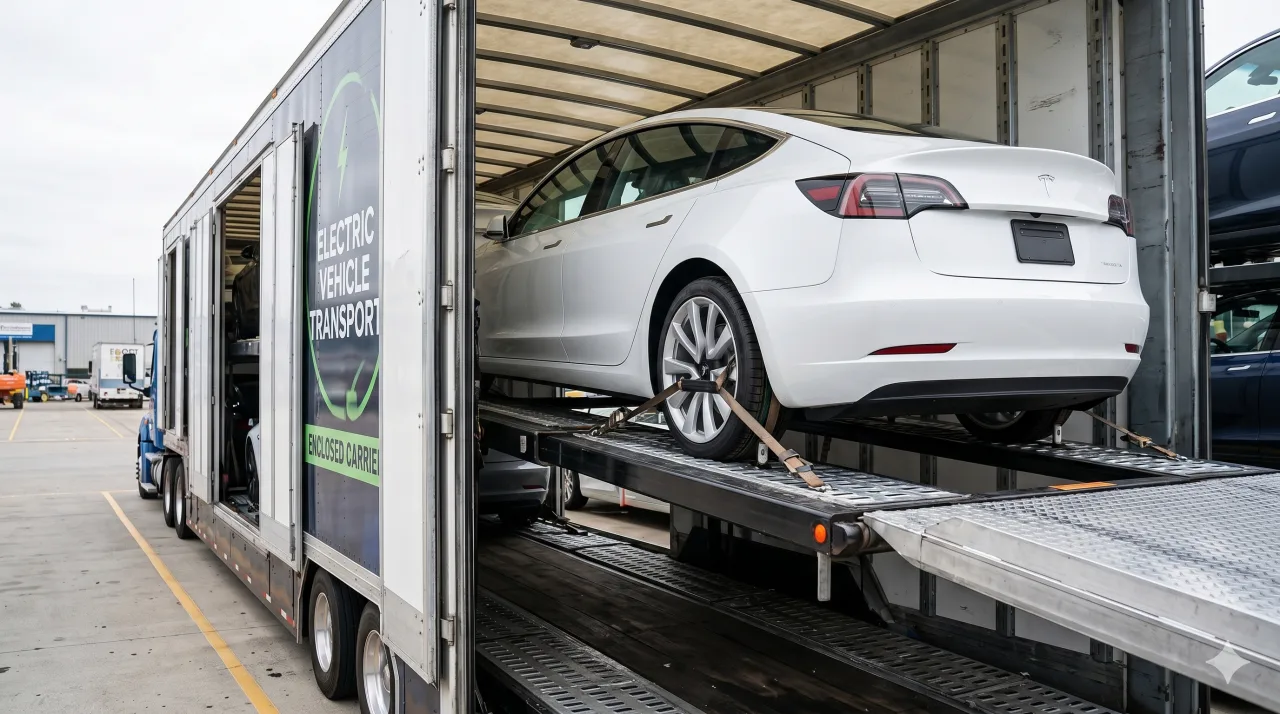
Why Shipping an Electric Vehicle Is Different From Gas-Powered Transport
If you're ready to ship an electric vehicle coast to coast, the first thing you need to know is this: EVs are not just heavy sedans. They carry high-voltage lithium-ion battery packs, regenerative braking systems, and software that responds to charge levels in ways a combustion engine never does. That changes everything about how a carrier loads, hauls, and delivers your car.
The good news? Transporting an EV is completely doable – and done safely every day across every major I-corridor in the country. The key is knowing what to ask your carrier before you hand over the keys.
At Car Shipping Hub, we've moved thousands of electric vehicles, from Tesla Model 3s headed to Tampa to Rivian R1Ts rolling into rural Montana. This guide covers everything you actually need to know — battery prep, carrier type, insurance, cost, and the questions that separate a smooth delivery from a nightmare.
The Battery Charge Rule Every EV Owner Gets Wrong
Here's the single most important prep step: charge your EV to between 30% and 50% before pickup — not full, not empty. Most carriers and DOT guidelines treat lithium-ion battery packs like hazardous materials above 80% charge. A fully charged pack generates more heat during transit and creates a greater fire risk if the pack is ever damaged.
On the flip side, letting your battery drop below 20% is also a problem. Some EVs lock their parking brake when the battery dies completely. Others go into "transport mode" only above a minimum charge level. If your car arrives dead, the carrier may need a specialized charger just to move it off the trailer — and that winch fee will come out of your pocket.
Insider Tip: Check your owner's manual for "transport mode" or "ship mode" before pickup day. Tesla, Rivian, and Lucid all have a dedicated shipping mode that disables sleep functions and prevents battery drain during multi-day hauls. Turn it on the night before your carrier arrives.
Brands with documented transport modes include Tesla (Settings → Service → Shipping Mode), Lucid Air, and Rivian. If your EV doesn't have a transport mode, keep it plugged in until the truck arrives, then confirm charge level with the driver.
Open Carrier vs. Enclosed Trailer: The Right Call for Your EV
Most gas-powered vehicles ship on open carriers — the same 9 or 10-car haulers you see grinding down I-80 through Nevada. Open transport is cheaper, faster to book, and covers the vast majority of routes without issue. For EVs, though, the calculation changes.
| Carrier Type | Cost vs. Open | EV Suitability | Best For | Weather Protection |
|---|---|---|---|---|
| Open Carrier (10-car) | Baseline | Acceptable | Budget-conscious moves, standard EVs | None |
| Open Carrier (2-car Hotshot) | +15–25% | Good | Faster pickup, lower decks | None |
| Enclosed Standard | +40–60% | Excellent | Most EVs, Tesla, Chevy Bolt | Full |
| Enclosed Soft-Side | +30–45% | Very Good | High-value EVs, SUVs | High |
| Enclosed Hard-Side Liftgate | +60–80% | Best | Lucid Air, Rivian, lowered EVs | Full + ground-level load |
Why does enclosed transport matter more for EVs? Three reasons. First, battery thermal management: cold weather, ice, and road spray can stress battery packs on open trailers. Second, low ground clearance: many EVs sit lower than standard vehicles, and some require a liftgate or soft loader to avoid scraping the undercarriage on trailer ramps. Third, high vehicle value: the average EV price in the US has crossed $55,000 — enclosed protection is worth the premium.
If you drive a standard-range Chevy Bolt or Nissan Leaf, open transport is fine. If you're moving a Lucid Air, a Rivian R1T, or a Porsche Taycan, pay for enclosed. Full stop.
What "Low Ground Clearance" Actually Costs You at Loading Time
A standard car carrier ramp has a loading angle of about 12–18 degrees. Most EVs clear it without issue. Some don't. The Tesla Model S Plaid, the Lucid Air, and lowered trims of the Porsche Taycan all sit below 5 inches of ground clearance in their stock ride height settings.
When a driver encounters a clearance problem at pickup, they have three options. They can use ramp extenders — aluminium planks that flatten the ramp angle. They can winch the vehicle (which costs $75–$150 extra). Or they can refuse the load entirely, leaving you to find a new carrier last-minute.
Before you book, measure your vehicle's ground clearance and tell the dispatcher. A good dispatcher – like the ones handling bookings at Car Shipping Hub – will flag the clearance spec to the carrier before dispatch day. This one phone call prevents 90% of pickup-day problems with low-slung EVs.
How to Ship an Electric Vehicle: Real Cost Ranges by Distance
Let's talk real numbers. EV shipping costs run about 15–25% higher than an equivalent gas-powered vehicle of the same size. That gap comes from three places: enclosed trailer preference, lower carrier availability (fewer drivers trained on EV protocols), and higher declared value affecting insurance.
| Distance Tier | Route Example | Open Carrier (EV) | Enclosed Carrier (EV) | Typical Transit |
|---|---|---|---|---|
| Under 500 miles | LA to San Francisco | $400–$600 | $600–$900 | 1–2 days |
| 500–1,000 miles | Dallas to Atlanta | $650–$900 | $950–$1,300 | 2–4 days |
| 1,000–2,000 miles | Chicago to Miami | $900–$1,250 | $1,300–$1,900 | 4–7 days |
| Cross-country (2,000+ miles) | New York to LA | $1,200–$1,700 | $1,800–$2,600 | 7–10 days |
Use Car Shipping Hub's cost calculator to get a live quote based on your exact route, vehicle specs, and carrier preference. Seasonal demand also moves these numbers — January through March is peak snowbird season on I-95 and I-75, pushing southbound rates up by $100–$200 on most routes.
Carrier Insurance for EVs: What the Bill of Lading Won't Tell You
Every legitimate shipment starts with a bill of lading — the legal document your driver signs at pickup and delivery that records your vehicle's condition. For EVs, you need to go further. Standard carrier cargo insurance typically covers $100,000 in vehicle value. That sounds like a lot until you're moving a Lucid Air Grand Touring at a $138,000 sticker.
Ask your carrier three direct questions. What is the per-vehicle cargo coverage limit? Does that limit apply to the vehicle's current market value or purchase price? And does their policy cover battery pack damage specifically? Some older cargo policies exclude high-voltage battery damage as a separate line item — a leftover clause from before EVs went mainstream.
If the declared value of your EV exceeds the carrier's cargo coverage, buy a third-party transport rider through your auto insurer before pickup day. This gap in coverage costs about $50–$150 for a 10-day transit period and is the only way to be fully protected.
EV-Specific Red Flags When Vetting a Carrier
The auto transport industry has its share of bad actors. When you're moving a $60,000+ battery-powered vehicle, the stakes are higher than shipping an old pickup. Check the FMCSA carrier database before you book — every licensed carrier must have a valid MC number and DOT number registered with the Federal Motor Carrier Safety Administration.
- No MC number: Walk away. A carrier without a motor carrier number cannot legally haul your vehicle across state lines.
- No EV experience: Ask point-blank: "How many electric vehicles has your company transported in the last 90 days?" If they can't answer, they haven't done it.
- Bait-and-switch deposit: A quote drops 20% after you pay a deposit—then jumps back up at pickup. This is the most common scam in the industry.
- No Bill of Lading at pickup: Never hand over your keys without a signed condition report. No exceptions.
- Pressure to skip the pre-inspection: Any driver who rushes past the walk-around is hiding something. Document every existing scratch, ding, and paint chip with photos before the car goes on the trailer.
Our trusted partner Furious Auto Shipping maintains full DOT compliance and handles EV transport with trained dispatch staff — worth asking about if you want a carrier with documented EV experience.
How to Book EV Transport: The Step-by-Step Process
Once you've picked a carrier and confirmed their EV credentials, here's exactly how the booking process works. See how the full process works on our overview page — but here's the EV-specific breakdown.
- Get at least 3 quotes and confirm each carrier's MC number before comparing prices.
- Specify your vehicle's ground clearance in the booking notes — not just make and model.
- Enable transport/ship mode on your EV the night before pickup.
- Charge to 30–50% and confirm battery level with the driver at pickup.
- Complete the Bill of Lading walk-around with photos from all four angles plus undercarriage if accessible.
- Confirm the delivery window and ask for a contact number for your assigned driver — not just a dispatch line.
- Inspect the vehicle at delivery before signing the Bill of Lading. Never sign "received in good condition" if you haven't checked the charge level, walked the body, and tested basic functions.
State-Specific Considerations for EV Owners Shipping West
California accounts for roughly 40% of all US EV registrations. That makes the state the single busiest origin and destination for EV transport in the country. If you're one of the thousands of EV owners in California shipping to or from the state, keep these points in mind.
California's Air Resources Board (CARB) rules don't affect transport directly — but they do mean your receiving state may require smog exemption documentation if you're registering a used EV. Arizona, Nevada, and Texas each have their own DMV transfer deadlines ranging from 10 to 30 days post-delivery. Handle the paperwork before the truck rolls, not after.
On the East Coast, Florida is the second-biggest EV receiving state, especially during January through March snowbird season. Southbound I-95 and I-75 corridors get congested with carriers, which pushes delivery windows out by 2–4 days during peak months. Book at least 2 weeks ahead if your delivery is anywhere in South Florida.
Frequently Asked Questions About EV Shipping
How much does it cost to ship a Tesla?
Shipping a Tesla typically costs between $900 and $2,200 depending on distance and carrier type. Open transport from Dallas to Los Angeles runs roughly $1,100–$1,400. Enclosed transport on the same route runs $1,600–$2,100. Car Shipping Hub can give you an exact quote based on your model and trim level.
Can you ship an electric vehicle on an open carrier?
Yes. Most EVs ship on open carriers without issue. Standard-range models like the Tesla Model 3 RWD, Chevy Bolt, and Nissan Leaf are good candidates for open transport. If your EV has very low ground clearance or high declared value, enclosed transport is the safer choice.
What charge level should my EV be at before shipping?
Keep your battery between 30% and 50% at pickup. A full charge creates excess heat and fire risk. An empty battery can lock the parking brake or prevent the carrier from moving the vehicle off the trailer. Enable your car's transport mode if it has one.
Does shipping an electric vehicle void the battery warranty?
No. Standard road transport does not void EV battery warranties from any major manufacturer. Battery warranties from Tesla, GM, Rivian, and Lucid cover defects in materials and workmanship — not transport-related wear. Confirm this with your dealer if you have a lease or extended warranty.
How long does it take to ship an electric car?
Transit times run roughly 400–500 miles per day depending on the route and driver regulations. A 2,800-mile cross-country haul from New York to Los Angeles typically takes 7–10 days. Short regional moves under 500 miles often deliver in 1–2 days.
What happens if my EV's battery is damaged during transport?
Document the damage on the Bill of Lading immediately and do not sign the delivery receipt as "received in good condition". File a claim with the carrier's cargo insurer within 24 hours. If the damage exceeds the cargo coverage limit, your third-party transport rider kicks in. Always photograph the vehicle before and after loading.
Ready to Ship Your EV? Get a Free Quote Today.
Car Shipping Hub connects you with vetted, EV-trained carriers at competitive rates. Tell us your route, your vehicle, and your timeline — we'll handle the rest.