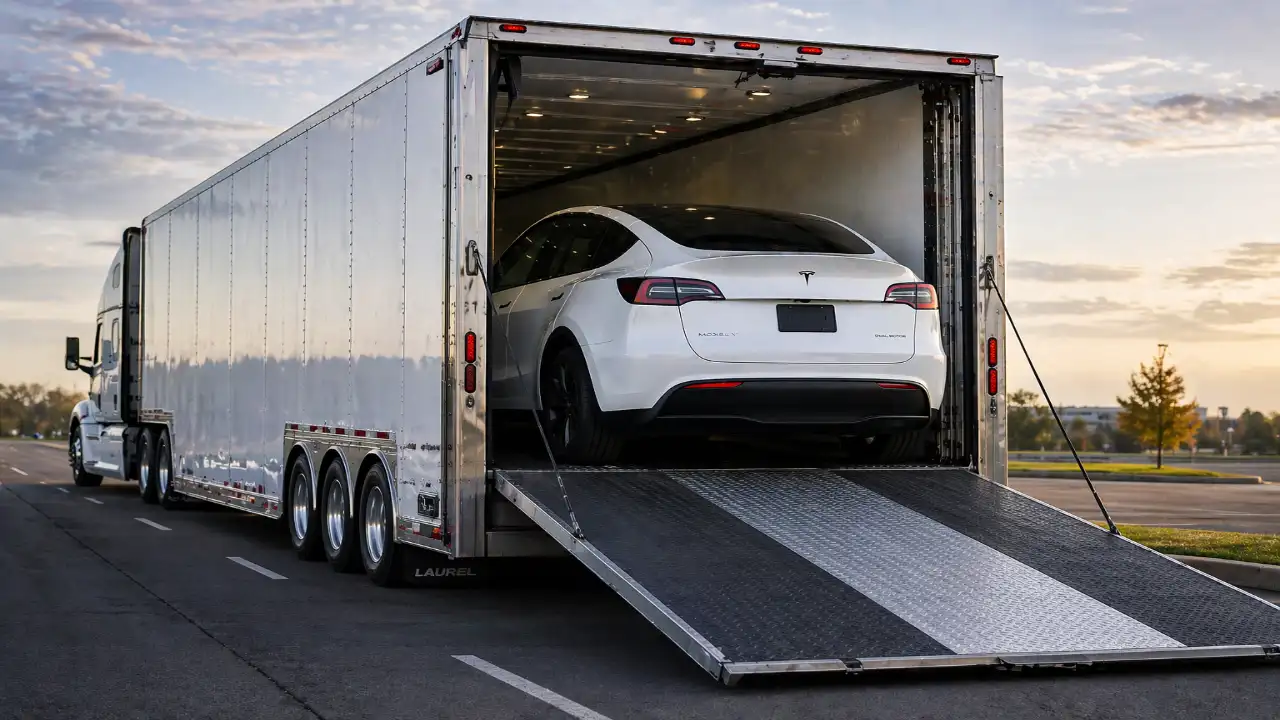
Why Shipping a Tesla Is Different From Shipping Any Other Car
You already know Teslas aren't ordinary vehicles. So it should come as no surprise that shipping a Tesla takes a little more planning than handing over the keys to a gas-powered sedan.
The differences start with the battery. A Tesla's large lithium-ion pack sits low in the chassis. That low center of gravity is great for handling — but it also means the car sits closer to the ground than most. Ground clearance on a Model 3 is just 5.5 inches. On a standard open carrier ramp, that can be a real problem.
Add in the software-controlled brakes, the lack of a traditional neutral gear on some models, and the regenerative braking system — and you've got a vehicle that genuinely needs a carrier who knows what they're doing. This guide walks you through every model, every cost factor, and every step of the process so your Tesla arrives the way it left: perfect.
Model-by-Model Breakdown: What Every Tesla Owner Needs to Know Before Transport
Not all Teslas load the same way. Here's what's specific to each model when it comes to auto transport.
Model 3: The One That Trips Up the Most Carriers
The Model 3 is Tesla's most popular vehicle — and the one that generates the most loading complaints. Its 5.5-inch ground clearance is tight for standard ramps. Before pickup, go into your Tesla app and enable Jack Mode under Service Settings. This locks the air suspension at maximum height and prevents the car from lowering itself mid-load.
Also confirm your Model 3 is in Transport Mode. You'll find it under Controls → Service → Towing. Transport Mode keeps the wheels free-rolling without the regenerative drag that can confuse drivers unfamiliar with EVs.
Model Y: The Easiest Tesla to Ship
Good news if you own a Model Y. Its 6.6-inch ground clearance gives carriers a bit more room to work with. The loading process is similar — Transport Mode on, Jack Mode if applicable — but the Y causes fewer headaches at pickup. It's also the most commonly shipped Tesla on the road, which means most experienced carriers have loaded one before.
Model S: High Value Means Enclosed Carrier, Full Stop
The Model S starts near $75,000 and climbs fast from there. It's also lower to the ground than the 3 or Y. An enclosed carrier isn't optional for the Model S — it's the only smart choice. The Plaid variant especially needs careful handling at both load and unload.
Make sure the carrier uses soft straps around the wheels, not chains or hooks on the frame. Frame contact on a Model S can cause cosmetic damage that costs thousands to fix.
Model X: The Falcon Wing Doors Change Everything
The Model X is the most complex Tesla to ship. Those signature Falcon Wing doors extend outward and upward when opening. On a multi-level open carrier, the overhead clearance between decks can be less than 12 inches. A Model X absolutely must ride on the top deck of any open carrier, or better yet, go enclosed.
Tell your carrier about the Falcon Wings before booking. Any carrier who doesn't ask about them probably hasn't shipped a Model X before — and that's a red flag worth taking seriously.
Open Carrier vs. Enclosed Transport: The Decision Tree for Tesla Owners
Most cars ship just fine on an open carrier — the kind you see hauling 7-9 vehicles on the highway every day. For most Teslas, you have a real choice to make here.
| Tesla Model | Recommended Carrier Type | Avg. Open Carrier Cost (1,000 mi) | Avg. Enclosed Carrier Cost (1,000 mi) | Key Loading Concern |
|---|---|---|---|---|
| Model 3 | Open (or Enclosed for peace of mind) | $750 – $950 | $1,100 – $1,400 | 5.5" ground clearance, low ramp angle needed |
| Model Y | Open | $750 – $1,000 | $1,100 – $1,450 | 6.6" clearance, most forgiving of the four |
| Model S | Enclosed strongly recommended | $850 – $1,100 | $1,250 – $1,700 | High value, low profile, soft-strap required |
| Model X | Enclosed strongly recommended | $900 – $1,200* | $1,350 – $1,800 | Falcon Wing doors — top-deck or enclosed only |
| *Model X on open carrier must be placed on top deck only. Confirm this in writing before booking. | ||||
If your Tesla is leased, check your lease agreement before booking open transport. Some Tesla lease contracts require enclosed shipping to avoid any damage liability issues. It's a five-minute check that could save you a headache later.
How Much Does Tesla Auto Transport Actually Cost? The Real Numbers
Tesla transport costs are driven by the same factors as any auto transport — distance, carrier type, time of year, and your pickup location. But a few EV-specific variables push the numbers higher than a comparable gas car.
First, weight. The Model S weighs nearly 4,900 lbs. That's heavier than most sedans by over 1,000 lbs. Carriers factor vehicle weight into the load distribution across the trailer, and heavier cars sometimes mean a lower available payout per mile for the carrier — which means your load takes longer to get picked up unless you price it right.
Second, the learning curve. Carriers who have never loaded a Tesla may decline the job or charge a premium. Always ask your broker: “Have the carriers on your network shipped Teslas before?” At Car Shipping Hub, we keep a vetted list of EV-experienced carriers exactly for this reason.
Insider Tip: Book your Tesla transport at least 10-14 days in advance, especially if you need enclosed shipping. Enclosed carriers run fewer trucks and fill up faster. Last-minute enclosed bookings can cost 30-40% more than planned bookings.
Here are realistic cost ranges by distance for a Tesla Model 3 or Y on an open carrier:
- Under 500 miles: $450 – $700
- 500 – 1,000 miles: $700 – $1,000
- 1,000 – 1,500 miles: $950 – $1,250
- 1,500 – 2,500 miles (cross-country): $1,100 – $1,600
For a real-time Tesla shipping estimate based on your exact route, plug your pickup and delivery zip codes into our cost calculator. Rates shift weekly based on carrier availability on specific lanes.
How to Prep Your Tesla for Pickup Day: A 7-Step Checklist
Prep is where most Tesla shipping problems start. A few minutes of setup prevents 90% of loading issues.
- Enable Transport Mode. Go to Controls → Service → Towing → Transport Mode. This disables regenerative braking and allows the wheels to roll freely. Without it, some carriers physically cannot push the car into position on the trailer.
- Activate Jack Mode (if air suspension equipped). Raises the suspension to its highest setting and locks it there. Find it under Service Settings in the Tesla app.
- Charge to 50%. Tesla recommends 50% battery for transport. Too low and you risk deep discharge during a multi-day haul. Too high and the battery management system works harder in hot weather.
- Disable Sentry Mode. Sentry Mode drains the battery while the car sits on the trailer. On a 5-day cross-country haul, that drain adds up. Turn it off before pickup and turn it back on after delivery.
- Turn off scheduled charging and climate preconditioning. Both will drain the battery if triggered remotely while the car is on the trailer.
- Document the car's condition. Walk around the car with your phone and record a video of every panel, rim, and piece of glass. This is your evidence if any damage claim ever comes up. The carrier will also complete a Bill of Lading at pickup — that's the official condition report. Read it carefully and note anything already there before you sign.
- Remove personal items and lower the antenna. Nothing loose inside the cabin. The shark fin antenna on most Teslas is fixed, but confirm there's no aftermarket roof rack or accessory that could catch wind on an open carrier at highway speed.
Want to understand the full shipping process from quote to delivery? Our step-by-step auto transport overview covers what happens between booking and final handoff.
5 Mistakes Tesla Owners Make When Booking Auto Transport
These mistakes show up again and again. Knowing them in advance saves you real money and real stress.
Mistake 1: Not Disclosing the Model X's Falcon Wing Doors
This is the single biggest loading problem in Tesla transport. A carrier shows up with a standard multi-deck open trailer. The Model X won't fit between the upper and lower decks without risking the doors. The driver either refuses the load or forces it — neither outcome is good. Always disclose the X's door configuration when you book.
Mistake 2: Booking the Cheapest Quote Without Verifying EV Experience
A quote $200 lower than the competition is appealing right up until your Model S gets loaded by a carrier who's never touched one. Always ask about EV experience. Reputable brokers document carrier history — including prior Tesla loads.
Mistake 3: Leaving Sentry Mode On
We said it above, but it's worth repeating. Sentry Mode will drain your battery during transport. On a 5-day cross-country haul at 50% charge, you may arrive with a critically low battery that won't even drive off the trailer without a charge.
Mistake 4: Ignoring the Bill of Lading
The Bill of Lading is a legal document. If the carrier marks a scratch wrong — or misses a dent that was already there — and you sign it, you've accepted that condition as fact. Read it thoroughly at both pickup and delivery before you put your name on it.
Mistake 5: Waiting Until the Last Minute for Enclosed Shipping
Enclosed carriers run 2-car, 3-car, and 5-car trailers. They fill fast, especially during peak season (October–January southbound, April–June northbound). A two-week lead time for enclosed transport is the minimum. Three weeks gives you much better rate options.
Seasonal Timing: When to Ship Your Tesla (And When to Wait)
Auto transport rates move with the seasons. If you have any flexibility in your timeline, knowing the patterns saves you real money.
Cheapest windows: February through April (before the spring rush), and September through mid-October (after the summer surge). These off-peak windows can knock $150–$300 off cross-country rates compared to peak season.
Most expensive windows: May through August (summer relocation season — colleges, military PCS orders, snowbird returns), and November through January (snowbird migration south on I-95 and I-75 in Florida, I-10 toward Arizona and Southern California).
The I-95 corridor from the Northeast down through the Carolinas to Miami is the highest-demand lane in the country. If you're shipping a Tesla from New York to Florida in December, expect to pay peak-season enclosed rates. The same route in March costs noticeably less.
Check current lane-specific pricing for your Tesla on our free auto transport quote calculator — rates update in real time based on actual carrier availability.
Frequently Asked Questions About Shipping a Tesla
Does shipping a Tesla void the warranty?
No. Professional auto transport does not void Tesla's warranty. The key is ensuring the carrier uses proper loading procedures — especially Transport Mode and soft wheel straps — so no mechanical or cosmetic damage occurs during the haul.
How long does it take to ship a Tesla across the country?
Cross-country Tesla transport typically takes 7 to 10 days from pickup to delivery. Carriers move roughly 400-500 miles per day. A New York to Los Angeles route covers about 2,800 miles, which puts delivery in the 6-8 day range after the car is picked up.
What charge level should my Tesla be at for shipping?
Tesla recommends 50% battery for transport. This balances battery health during the haul with enough charge for the carrier to move the car on and off the trailer. Disable Sentry Mode and scheduled charging before pickup to prevent drain during transit.
Do I need enclosed shipping for my Tesla Model Y?
Not necessarily. The Model Y ships safely on open carriers thanks to its 6.6-inch ground clearance. That said, if your Model Y has a premium paint finish or aftermarket upgrades, enclosed shipping adds a layer of protection worth the extra $200-$400. Car Shipping Hub can quote both options side by side.
Can my Tesla be shipped internationally?
Yes, but international EV shipping involves additional steps — battery documentation, customs declarations, and compliance with destination-country import regulations. Shipping to Hawaii requires a specialized RO/RO (roll-on/roll-off) vessel or container ship. Contact Car Shipping Hub directly for international Tesla transport quotes, as pricing and timelines vary significantly by destination.
What is Transport Mode and do I really need it?
Transport Mode is a software setting that disables regenerative braking and allows the wheels to roll freely. Without it, the carrier may not be able to position the car on the trailer safely. It's not optional — enable it before every Tesla transport, regardless of model.
Ready to Ship Your Tesla? Get a Free, Instant Quote
Car Shipping Hub works with a vetted network of EV-experienced carriers across every major route in the country. Whether you're moving a Model 3 from Chicago to Phoenix or a Model X from Seattle to Miami, we match you with carriers who've done it before — and done it right.
Open carrier. Enclosed. Door-to-door. Terminal-to-terminal. We cover all of it.
Get Your Free Tesla Shipping Quote Now — no commitment, no spam, just a real number for your route in under 60 seconds.