The Tech Exodus: Hauling Vehicles West to East Across the Sun Belt
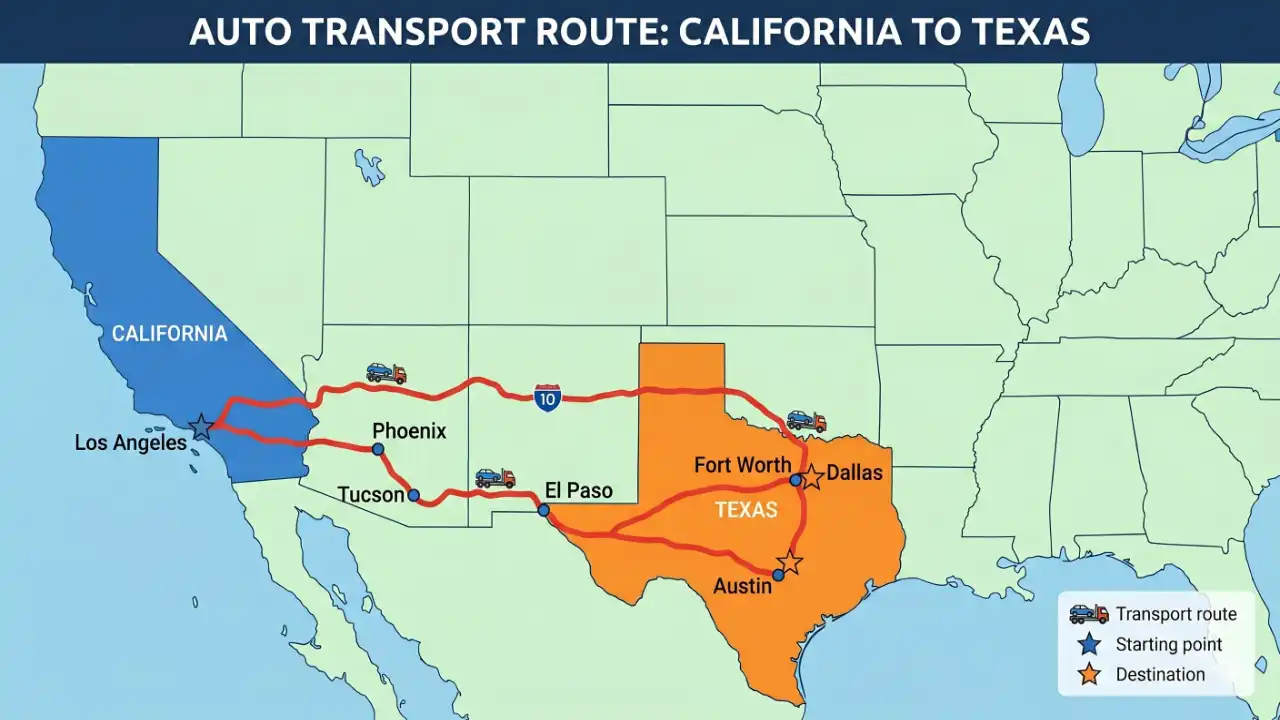
Car Shipping from California to Texas has surged over the last five years. Thousands of tech workers, remote employees, and corporate relocatees are leaving Los Angeles, San Jose, and San Francisco for Austin, Dallas, and Houston every single month. They trade California's income tax for Texas's zero state income tax. They swap Pacific Coast traffic for wider Texas roads. The journey covers roughly 1,400 to 1,600 miles depending on your exact start and end points. Carriers typically roll east on I-10 through the Sonoran Desert or cut across on I-20 through El Paso and Midland. Car Shipping Hub has handled thousands of these westbound-to-eastbound moves. Our dispatch team knows every truck stop, weigh station, and construction zone on this corridor. Whether you are moving from San Diego, Sacramento, or the Bay Area, we connect your vehicle to a vetted carrier fast.
Market Driver: Corporate Relocation / Tech Exodus
California-to-Texas is one of the fastest-growing relocation corridors in the US. Texas has no state income tax. Housing costs are dramatically lower. Companies like Tesla, Oracle, HP, and Charles Schwab have moved headquarters to the Austin-Dallas metro. Their employees follow with relocation packages that often include vehicle shipping reimbursement. This is not a seasonal spike — it is a sustained, structural migration trend that keeps truck availability high and transit times short on this route year-round.
Why the I-10 Sun Belt Corridor Stays One of the Busiest in the Nation
The I-10 corridor between California and Texas ranks among the top five most-trafficked auto transport lanes in the country. Carriers run it daily because load volume is consistently high in both directions. California to Texas auto transport demand spikes every summer as corporate relocation season hits peak. University of Texas at Austin and Texas A&M University drive student move-in surges in late August. Fort Bliss in El Paso and Joint Base San Antonio generate steady military PCS traffic year-round. The combination of corporate, military, and student demand means trucks rarely run empty. That keeps your shipping cost competitive and your transit window short compared to thinner routes.
Rolling East on I-10 and I-20: The Real Logistics of This Run
The primary artery for shipping a car from California to Texas is I-10, running from Los Angeles or San Diego east through Phoenix, Tucson, El Paso, and into San Antonio and Houston. Carriers bound for Dallas or North Texas often peel north at El Paso onto I-20 through Midland, Odessa, and Abilene. A third option is I-40 from Barstow through Albuquerque and Amarillo for North Texas drops. Each route has its own quirks. I-10 through the desert is fast but brutal on fuel costs due to long empty stretches. I-20 through West Texas is flatter but has significant crosswind exposure between Odessa and Abilene. Truck drivers must navigate the TxTag toll system once inside Texas, particularly on State Highway 130 and I-35 bypasses around Austin.
✅ The Smooth Desert Sprint
I-10 from the California-Arizona state line east through Tucson and into El Paso runs clean with minimal construction delays. This stretch moves fast. Carriers make excellent time here, often covering 500 miles in a single driving shift.
⚠️ The West Texas Crosswind Zone
Between Odessa and Abilene on I-20, open plains create sustained crosswinds that regularly exceed 35 mph. Open carriers carrying tall SUVs and pickups feel this. Drivers slow down and fuel consumption spikes. This adds 2 to 4 hours to an already long haul.
🔴 The I-35 Austin Bottleneck
If your delivery is in Austin, the final approach on I-35 through downtown is notoriously gridlocked. Construction has been ongoing for years. An 18-wheeler delivering in South Congress or East Austin may need to meet you at a large parking area — a Home Depot or Walmart Supercenter off the highway — rather than your front door.
Desert Heat and Gulf Humidity: The Climate Gauntlet Between CA and TX
When shipping a car from California to Texas, you are moving from a Mediterranean or semi-arid Pacific climate into a hot subtropical and semi-arid Texas climate. The Sonoran Desert crossing between Yuma and Tucson regularly sees pavement temperatures above 140°F in summer. Once you reach Houston or the Gulf Coast, high humidity can cause condensation issues on vehicles that have been sealed on an enclosed trailer.
- Extreme desert heat between Blythe, CA and El Paso, TX can stress tires and affect fluids on vehicles that are not properly prepped for transport
- West Texas dust storms — known locally as haboobs — can reduce visibility to near zero on I-20 and I-10 between El Paso and Midland, occasionally delaying carriers by several hours
- Gulf Coast humidity in Houston creates a corrosion-risk environment for vehicles sitting on open carriers for extended periods, especially for cars with existing paint chips or rust
Recommendation: For standard sedans and SUVs, open transport handles this route well in fall, winter, and spring. If you are shipping in July or August, consider enclosed transport to protect your vehicle from extreme desert sun exposure and the rare but damaging West Texas dust storm. Luxury vehicles and classic cars should always use enclosed transport regardless of season.
The I-10 Bait and Switch: A Scam Running This Corridor
This route attracts low-ball brokers who quote you $600 to $700 knowing the real carrier cost is $950 or more. Here is how it works: a discount broker posts your load at an unsustainably low rate on the central dispatch board. No legitimate carrier picks it up. Days pass. Then the broker calls you back and says fuel costs spiked or no trucks are available — but for an extra $300, they can 'make it happen.' You pay more than if you had booked correctly on day one. Car Shipping Hub operates differently. We quote based on live carrier market data, not a lowball number designed to win your click. Our rates are firm and backed by a vetted carrier network with verified DOT numbers and active cargo insurance.
⚠️ Warning: If a quote looks too good to be true, verify the broker's MC number and bond status.
From LA's Tight Grid to Texas Driveways: Pickup and Drop-Off Realities
California Pickups: Los Angeles presents the single biggest access challenge on this route. Narrow residential streets in Silver Lake, Echo Park, or West Hollywood cannot accommodate a full 75-foot auto transport rig. Drivers will coordinate a meeting point — often a nearby strip mall or big-box parking lot off a main boulevard. In San Francisco, hills and one-way streets in neighborhoods like Noe Valley or the Mission require the same approach. San Diego and Sacramento are far more straightforward with wider suburban streets and easy freeway access. Always confirm your pickup address with your carrier dispatcher 48 hours before scheduled pickup.
Texas Deliveries: Most Texas destinations are truck-friendly by default. Houston's sprawling suburban grid, Dallas's wide collector roads, and San Antonio's highway access make final-mile delivery simple in most cases. The exception is Austin. Gated condo complexes downtown and the dense grid of East Austin near UT Austin's campus can block 18-wheeler access. If you are moving to a gated community in The Woodlands north of Houston or a secured ranch property outside San Antonio, notify your Car Shipping Hub coordinator in advance. We will arrange a terminal meet at a pre-approved large-lot location nearby.
What Our CA-to-TX Dispatchers Know That Most Brokers Won't Tell You
Pro Tip: Book your shipment at least 10 to 14 days before your target pickup date if you are moving during June, July, or August. This is peak corporate relocation season. Carriers on the California-to-Texas corridor fill up fast because load volume spikes with university move-ins at UT Austin and Texas A&M. Booking late in peak season means you compete with dozens of other shippers for the same truck space. Car Shipping Hub dispatchers also recommend listing your vehicle as 'flexible on dates' if you can afford a two to three day window. Flexible loads get assigned faster because carriers can route-optimize more easily. A flexible booking often results in an earlier pickup and a lower final rate.
Summer Surcharges and Desert Fuel Costs: Pricing This Move Honestly
The car shipping cost from California to Texas typically ranges from $950 to $1,450 for open transport and $1,350 to $2,100 for enclosed. Several factors move that number up or down. First, your exact city pair matters. Shipping from Los Angeles to Dallas is a heavier-trafficked lane than shipping from Fresno to Amarillo — counter-intuitively, popular lanes are often cheaper because more trucks run them. Second, the time of year is critical. July and August add 15% to 25% to baseline rates because demand outpaces truck supply. Third, vehicle size drives cost directly. A pickup truck or large SUV takes more trailer space than a sedan, and carriers price per axle and per foot. West Texas fuel costs — diesel prices between El Paso and Midland — are built into every carrier's quote on this route. When you ship a car from California to Texas with us, those fuel factors are already baked in. No surprise invoices. For guaranteed pricing, check our Vehicle Shipping Quotes.
Estimated Transit Times: California to Texas
Note: These are estimated transit times for standard dispatch. Severe weather or traffic conditions may impact actual delivery dates.
| Origin | Destination | Miles | Transit Time |
|---|---|---|---|
| Los Angeles, CA | Houston, TX | 1,550 miles | 3 – 5 Days |
| San Diego, CA | Dallas, TX | 1,400 miles | 3 – 5 Days |
| San Francisco, CA | Austin, TX | 1,750 miles | 4 – 6 Days |
| Sacramento, CA | San Antonio, TX | 1,800 miles | 4 – 6 Days |
| Fresno, CA | El Paso, TX | 990 miles | 2 – 4 Days |
Average Cost Ranges: Open vs. Enclosed
Note: Prices shown are market averages. Actual rates vary due to fuel surcharges and seasonal demand. Contact us for a precise quote.
| Vehicle | Open | Enclosed | Why? |
|---|---|---|---|
| Sedan | $950 – $1,150 | $1,350 – $1,650 | Standard footprint; most common load type on this lane, keeping open rates competitive |
| Small SUV | $1,050 – $1,250 | $1,450 – $1,750 | Slightly taller profile adds minor enclosed surcharge for roof clearance in the trailer |
| Large SUV | $1,200 – $1,400 | $1,700 – $2,000 | Full-size SUVs consume more trailer space per load; carriers price by footprint and height |
| Pickup Truck | $1,150 – $1,350 | $1,650 – $1,950 | Long-bed trucks can be difficult to stack on multi-level open carriers, reducing per-truck capacity |
| Luxury / Exotic | $1,300 – $1,500 | $1,950 – $2,400 | Enclosed is strongly recommended; West Texas dust and desert UV exposure pose real paint and finish risk |
The Numbers Behind the Great California-Texas Migration
Between 2020 and 2023, the US Census Bureau recorded that Texas gained more net domestic in-migrants from California than from any other state — over 100,000 people per year at the peak. The Austin-Round Rock metro alone absorbed so many California transplants that local residents coined the phrase 'Don't California My Texas.' This mass movement created one of the most reliable and well-serviced auto transport corridors in North America, with carriers running daily loads in both directions.
Explore Related Routes
Ready to Ship Your Car to Texas?
Carrier space on the California-to-Texas corridor fills up fast every summer — especially for Austin and Dallas drops. Get your firm, no-surprise quote from Car Shipping Hub right now and secure your pickup date before trucks book out.
Lock In My California to Texas Rate Now
How long does shipping a car from California to Texas take?
Most California to Texas shipments take 3 to 6 days once a carrier picks up your vehicle. The exact time depends on your specific city pair. Los Angeles to Houston runs about 3 to 5 days on I-10. San Francisco to Dallas can take 4 to 6 days due to the longer driving distance. Keep in mind that dispatch — the time between booking and actual pickup — can add 1 to 5 days depending on truck availability in your area. Booking 10 to 14 days ahead eliminates most of that wait, especially during summer peak season.
How much does it cost to ship a car from California to Texas?
Open transport on this route typically costs between $950 and $1,450. Enclosed transport runs $1,350 to $2,100 or more for luxury and exotic vehicles. Costs spike 15% to 25% in June, July, and August due to corporate relocation season and university move-in demand at schools like UT Austin and Texas A&M. The cheapest months to ship are January and February. Your vehicle size, pickup location, and the flexibility of your dates all affect the final price. Car Shipping Hub provides firm, upfront quotes with no surprise fees.
Is Enclosed Transport necessary for California to Texas?
Enclosed transport is not required for standard vehicles on this route, but it is strongly recommended for luxury cars, classic cars, and exotics. The route crosses some of the most extreme desert terrain in North America. Summer pavement temperatures between Blythe and El Paso regularly exceed 140 degrees Fahrenheit. West Texas between Odessa and Midland is prone to sudden dust storms that can sandblast paint on open carriers. If your vehicle is a daily driver valued under $50,000, open transport is fine. If it is worth more than that, or if it has a custom paint job or a convertible soft top, pay the premium for enclosed.
Can I pack personal items in my car when shipping to Texas?
Yes, you can usually pack up to 100 pounds of personal items in the trunk or cargo area. However, everything must stay below the window line so the driver can see safely. Personal items are not covered by the truck's cargo insurance.
Can I ship a car from California to Texas if it doesn't run?
Yes, we can ship an inoperable vehicle. We just need to know in advance so we can send a truck equipped with a winch to safely pull your car onto the trailer. This adds a standard winch fee to your total cost.