The Great Snowbird Escape: Hauling Your Car South Before Winter Hits
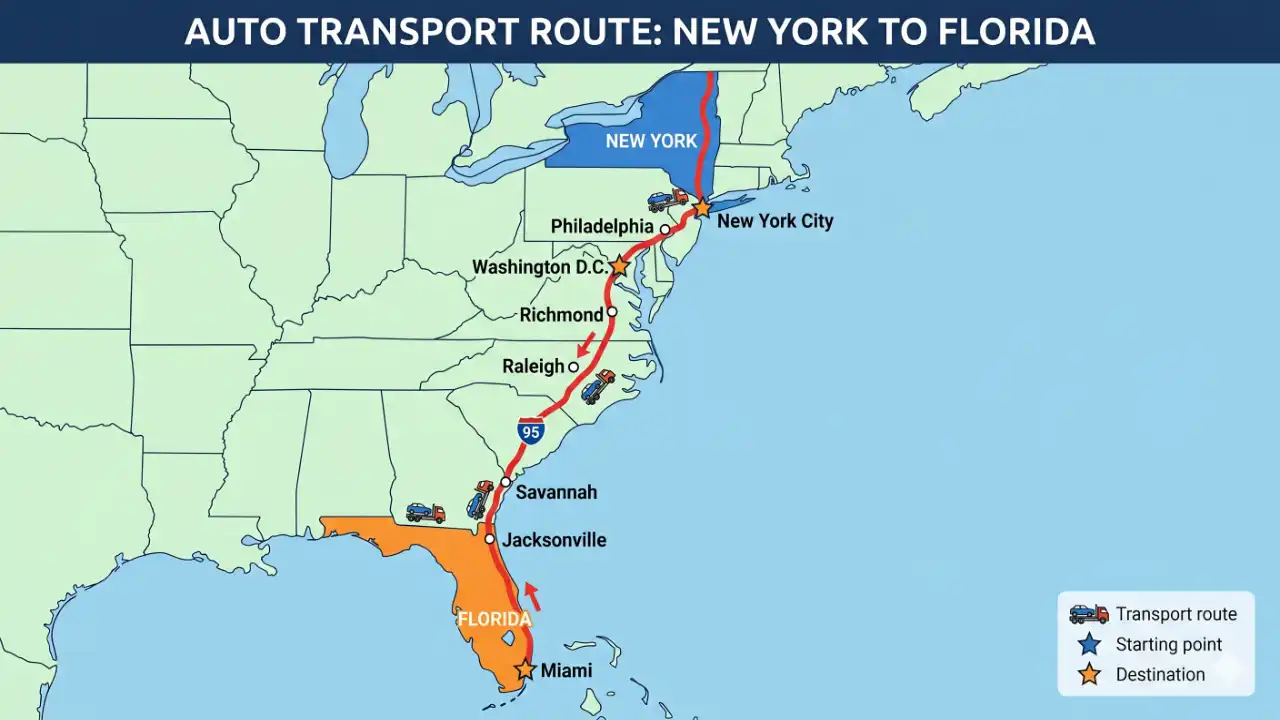
Car Shipping from New York to Florida is one of the most active corridors in the entire US auto transport industry. Every fall, hundreds of thousands of New Yorkers pack up and head south — and their cars go with them. The route spans roughly 1,200 to 1,350 miles, threading down the Eastern Seaboard through New Jersey, Delaware, Maryland, Virginia, the Carolinas, and Georgia before crossing into the Sunshine State. Major cities like Newark, Philadelphia, Baltimore, Washington D.C., Richmond, and Jacksonville all sit along this well-traveled artery. Car Shipping Hub moves vehicles on this corridor year-round. But October through December is when demand truly explodes. Open carriers fill up fast. Prices climb. If you are planning a southbound move this season, booking early is not optional — it is essential. Our dispatchers know this route inside and out, and they are ready to lock in your rate before the rush hits.
Market Driver: Snowbird
New York and Florida share one of the most well-documented seasonal migration patterns in North America. Millions of northeasterners — retirees, part-year residents, and remote workers — flee New York's brutal winters for Florida's year-round warmth. This is the classic "Snowbird" route. Cities like Boca Raton, Naples, Sarasota, and Fort Lauderdale swell with New York license plates every October. The contrast is simple: New York winters are icy, slushy, and punishing on vehicles. Florida offers 75-degree weather and no state income tax.
The I-95 Snowbird Corridor: Why This Is America's Busiest Auto Transport Lane
Few routes in the country carry the sheer volume of New York to Florida auto transport traffic that I-95 does every autumn. This corridor is not just popular — it is legendary in the trucking and logistics world. Carriers plan their entire fall schedules around it. The demand is driven by a massive, predictable wave of seasonal migration. Snowbirds book months in advance. Retirees coordinate their southbound move with lease expirations and hurricane season endings. Corporate relocation teams from New York's financial sector also move employees to Tampa and Miami offices regularly. Add in the Florida university system's fall enrollment — schools like the University of Florida in Gainesville and the University of Miami draw students relocating from the Northeast — and you have a corridor that is structurally, permanently busy.
Running I-95 South: The Real Logistics of This 1,270-Mile Haul
The primary artery for shipping a car from New York to Florida is I-95 South, running virtually the entire length of the Eastern Seaboard. Carriers depart from the New York metro area — typically staging near Newark, NJ or the Meadowlands to avoid Manhattan's bridges and tunnels — and drive straight south. The route passes through Philadelphia, Wilmington, Baltimore's Fort McHenry Tunnel interchange, Washington D.C.'s Capital Beltway (I-495), Richmond, Fayetteville, and Columbia (SC) before hitting Savannah, GA and finally crossing into Jacksonville, FL. From Jacksonville, carriers split: westbound loads continue on I-10 toward Tallahassee and Pensacola, while southbound traffic presses down I-95 to Miami, or cuts across on I-4 toward Tampa and Orlando. Ship a car from New York to Florida, and your vehicle will spend the majority of its journey on one of the most surveilled, maintained, and truck-heavy highways in the nation.
✅ The Smooth Corridor
Once past the New York metro area and into New Jersey and Delaware, I-95 opens up. This mid-Atlantic stretch — from Wilmington through Baltimore and into Virginia — moves well outside of rush hour. Carriers make excellent time here.
⚠️ The D.C. and Richmond Bottleneck
The Washington D.C. Beltway (I-495) interchange is a notorious choke point. 18-wheelers slow significantly through the Springfield Interchange and again near Richmond's I-64 split. Drivers often time this stretch for overnight runs to avoid daytime gridlock.
🔴 The Florida Last Mile
Florida's SunPass-managed toll plazas and the dense residential grid of South Florida communities — particularly the narrow streets of Coral Gables and gated HOA communities in Boca Raton and Naples — can force drivers to arrange a nearby meeting point at a large parking area like a Walmart Supercenter or Home Depot rather than pulling a full 18-wheeler into tight subdivisions.
Swapping Ice for Humidity: Weather Risks on the NY-to-FL Southbound Run
When shipping a car from New York to Florida, you are moving from a four-season northeastern climate to a subtropical environment. That transition brings specific risks for your vehicle and for the carriers hauling it.
- Road Salt Corrosion (Origin Risk): New York roads are heavily salted from November through March. If your car has accumulated salt buildup on the undercarriage, shipping it south before a thorough wash can trap corrosive material — especially in wheel wells and frame rails.
- Carolinas Ice Storm Belt (Transit Risk): The I-95 corridor through North and South Carolina sees unpredictable late-season ice storms — particularly in January and February. These events can delay carrier transit by 24 to 48 hours and occasionally require trucks to stage at rest stops until roads clear.
- South Florida Heat and Humidity (Destination Risk): Arriving vehicles parked in direct South Florida sun can heat interiors to extreme temperatures. Leather seats, dashboards, and electronics are vulnerable. Request that your carrier deliver during morning hours when possible.
Recommendation: For standard sedans and SUVs, open transport is fine for this route during October through December — the weather window is favorable. If you are shipping a luxury vehicle, a classic car, or a convertible with a soft top, enclosed transport is the right call year-round on this corridor. Florida's afternoon thunderstorms and the salt-heavy coastal air near the I-95 Jacksonville stretch make enclosed trailers worth the premium.
The I-95 Bait & Switch: Low Quotes That Disappear at Pickup
This is the most common scam on the New York to Florida corridor, and it is almost always tied to peak snowbird season. Here is how it works: a low-tier broker posts an artificially low quote — sometimes $200 to $300 below market rate — to win your booking. They collect a deposit. Then, as October approaches and carrier capacity tightens, they come back with a "revised" rate, citing fuel surcharges, last-minute carrier fees, or toll increases through Florida's SunPass network. By that point, you have already paid a deposit and your move date is looming. Legitimate companies like Car Shipping Hub publish guaranteed pricing at booking — your rate does not change after you sign. Always verify a broker's FMCSA Motor Carrier (MC) number and confirm their surety bond is active before handing over any money.
⚠️ Warning: If a quote looks too good to be true, verify the broker's MC number and bond status on the FMCSA website before paying any deposit.
From the Outer Boroughs to the Gated Communities: Navigating Both Ends of This Route
New York Pickups: Manhattan is effectively off-limits for full-size car carriers. The low clearances of the Brooklyn-Battery Tunnel, the weight restrictions on several East River bridges, and the city's commercial vehicle regulations make it impractical for an 18-wheeler to navigate most of the five boroughs. Car Shipping Hub dispatchers typically coordinate pickups at staging areas in Newark, NJ (near the Port Newark-Elizabeth Marine Terminal area), or at large open lots in Yonkers, the Meadowlands, or along the service roads of I-278 on Staten Island. If you live in Brooklyn, Queens, or Manhattan, plan to drive 10 to 20 minutes to meet your carrier at a pre-arranged wide-access location.
Florida Deliveries: Most of Florida's suburban destinations are carrier-friendly. Wide roads, large cul-de-sacs, and ample shopping center parking make final-mile delivery smooth in cities like Orlando, Tampa, and Jacksonville. However, South Florida presents two specific challenges. First, gated HOA communities in areas like Boca Raton, Naples, and The Villages require prior gate authorization for commercial vehicles — arrange this with your HOA before your car arrives. Second, the historic and narrow streets of Coral Gables and parts of Key West are physically impassable for an 18-wheeler. Clients in those areas should plan to meet their carrier at a nearby large-format retail parking lot. Florida uses the SunPass transponder system for toll roads — this is the carrier's responsibility, but toll costs on the Florida Turnpike and I-75 Alligator Alley are factored into your shipping rate.
What Car Shipping Hub Dispatchers Tell Every New York Client Before October
Pro Tip: Book your southbound Florida shipment no later than mid-September if your move falls between October 1 and December 15. This is not a soft suggestion — it is a hard logistics reality. Car Shipping Hub dispatchers watch carrier availability on the I-95 corridor tighten dramatically after Labor Day. By October 1, open carrier space from the New York metro area to South Florida can fill 7 to 10 days out. Clients who book in late September lock in lower rates and get first pick of dispatch windows. Clients who wait until October often pay 20 to 30 percent more and wait longer for pickup. Additionally, if you are shipping to a gated community in Boca Raton, Naples, or Sarasota, send your HOA the carrier's license plate and DOT number at least 48 hours before the delivery window. Gate delays push our drivers behind schedule and can affect the next customer on the route.
October Surcharges and Off-Season Deals: What It Really Costs to Ship South
The car shipping cost from New York to Florida is one of the most season-sensitive price points in the entire auto transport industry. In summer — June through August — open transport for a standard sedan runs approximately $850 to $1,050. That same shipment booked in October or November can climb to $1,200 to $1,400 as snowbird demand absorbs every available carrier slot. Enclosed transport carries a consistent premium of 40 to 60 percent above open rates year-round, typically landing between $1,400 and $1,900 for this corridor regardless of season. Several additional factors drive your final rate: vehicle size (full-size trucks and large SUVs cost more due to trailer space consumed), pickup location (Newark staging is cheaper than a residential Brooklyn pickup requiring special coordination), and delivery zip code (South Florida destinations below West Palm Beach cost slightly more than Orlando or Jacksonville due to carrier repositioning costs). New York to Florida vehicle transport rates also reflect tolls — I-95 through Maryland, Delaware, New Jersey, and Florida's Turnpike system all carry commercial vehicle toll fees that are embedded in your quote. For an exact, locked-in number, use our Vehicle Shipping Quotes calculator and get a guaranteed rate in under 60 seconds.
Estimated Transit Times: New York to Florida
Note: These are estimated transit times for standard dispatch. Severe weather, D.C. Beltway congestion, or Carolina ice events may impact actual delivery dates.
| Origin | Destination | Miles | Transit Time |
|---|---|---|---|
| New York City, NY | Jacksonville, FL | 1,020 miles | 3 - 4 Days |
| Albany, NY | Orlando, FL | 1,240 miles | 3 - 5 Days |
| Buffalo, NY | Tampa, FL | 1,310 miles | 4 - 6 Days |
| New York City, NY | Miami, FL | 1,280 miles | 4 - 6 Days |
| Rochester, NY | Fort Lauderdale, FL | 1,380 miles | 4 - 6 Days |
Average Cost Ranges: Open vs. Enclosed Transport — New York to Florida
Note: Prices shown are market averages for the October to December peak season window. Off-season rates (June-August) run 15-25% lower. Contact Car Shipping Hub for a precise, guaranteed quote.
| Vehicle | Open | Enclosed | Why? |
|---|---|---|---|
| Sedan | $850 - $1,100 | $1,350 - $1,650 | Standard size fits easily on open multi-car carriers, keeping costs efficient. Enclosed adds weather and road debris protection. |
| Small SUV | $950 - $1,200 | $1,450 - $1,750 | Slightly larger footprint on the trailer increases per-unit cost. Enclosed recommended for lease returns to avoid ding claims. |
| Large SUV | $1,100 - $1,350 | $1,650 - $1,950 | Full-size SUVs consume significant trailer space. Limited carrier availability during snowbird peak pushes open rates up sharply. |
| Pickup Truck | $1,050 - $1,300 | $1,600 - $1,900 | Truck beds add height and length. Some carriers require tailgate removal for safe loading. Enclosed protects bed-liner from I-95 road debris. |
| Luxury / Exotic | $1,200 - $1,500 | $1,800 - $2,400 | Enclosed transport is the industry standard for vehicles over $60K. South Florida's salt air and UV exposure make open transport a liability for exotic finishes. |
The Numbers Behind America's Most Famous Seasonal Migration
Florida receives more seasonal migrants from New York than from any other state in the country. The US Census Bureau has consistently tracked New York as Florida's single largest source of new residents and part-year inhabitants for over two decades. The stretch of I-95 between Jacksonville and West Palm Beach is sometimes informally called the "New York Expressway" by Florida transportation planners — a nod to the volume of northeastern plates that flood it every October. At peak snowbird season, auto transport carriers report that New York to Florida bookings can account for up to 30 percent of all southbound East Coast vehicle shipments.
Explore Related Routes
- Car Shipping from New Jersey to Florida
- Virginia to Florida Auto Transport
- North Carolina to Florida car shipping
- Auto Transport South Carolina to Florida
- Check rates from Georgia to Florida
Ready to Ship Your Car South Before the Rush?
Snowbird season carrier slots fill up every October — and rates climb with every booking that beats yours. Get your guaranteed Car Shipping Hub rate right now and secure your spot before the I-95 corridor locks up.
How long does shipping a car from New York to Florida take?
The typical transit time for New York to Florida auto transport is 3 to 6 days. The distance runs approximately 1,020 to 1,350 miles depending on your exact pickup and delivery locations. Carriers generally cover 400 to 500 miles per day, accounting for federally mandated Hours of Service driving limits and rest stops. Jacksonville and northern Florida destinations tend to land on the shorter end at 3 to 4 days. Miami and South Florida destinations can take 5 to 6 days, especially during peak snowbird season when carriers manage multiple stops along the Florida coast. Delays are most common in October and November due to high traffic volume on I-95 through the Washington D.C. area and occasional ice events in the Carolinas during late-season runs.
How much does it cost to ship a car from New York to Florida?
The cost to ship a car from New York to Florida ranges from approximately $850 to $1,400 for open transport, depending on the season. The single biggest pricing factor on this specific corridor is the snowbird rush. Rates in October, November, and December can run 20 to 30 percent higher than summer pricing because carrier capacity on I-95 southbound fills up fast. If you book in June, July, or August, you will find the most competitive open transport rates. Enclosed transport runs $1,350 to $1,950 regardless of season due to the premium trailer equipment required. Vehicle size, your exact pickup zip code in New York, and your delivery zip code in Florida all influence the final number. Use our online calculator for a guaranteed, real-time rate.
Is Enclosed Transport necessary for New York to Florida?
Enclosed transport is not strictly required for this route, but it is the smart choice for certain vehicles and seasons. Open transport works well for most standard sedans and SUVs traveling between October and April when weather along the corridor is mild. However, if you are shipping a luxury vehicle, a classic or collector car, a convertible with a soft top, or any vehicle worth over $60,000, enclosed transport is strongly recommended. The I-95 corridor through the Carolinas and Georgia subjects open vehicles to road debris, diesel exhaust, and the occasional rock chip. South Florida's UV intensity, salt air near coastal delivery zones, and afternoon thunderstorm season add additional risk to an already vulnerable vehicle. Enclosed carriers eliminate all of those concerns.
Can I pack personal items in my car when shipping to Florida?
Yes, you can usually pack up to 100 pounds of personal items in the trunk or cargo area. However, everything must stay below the window line so the driver can see safely. Personal items are not covered by the truck's cargo insurance. Carriers are not liable for damage to items left inside the vehicle. Florida-bound shipments are also subject to D.O.T. inspection checkpoints in Georgia, and carriers transporting vehicles with visible excess cargo may be flagged for secondary inspection, which can delay your delivery.
Can I ship a car from New York to Florida if it doesn't run?
Yes, we can ship an inoperable vehicle. We just need to know in advance so we can send a truck equipped with a winch to safely pull your car onto the trailer. This adds a standard winch fee to your total cost. For New York pickups, inoperable vehicle coordination can be more complex if your staging location has limited flat-surface access. Notify Car Shipping Hub at the time of booking — our dispatch team will match your inoperable vehicle with the right equipped carrier for both your New York pickup point and your Florida destination.