The Great Snowbird Migration: Hauling Your Vehicle from the Prairie State to the Sunshine State
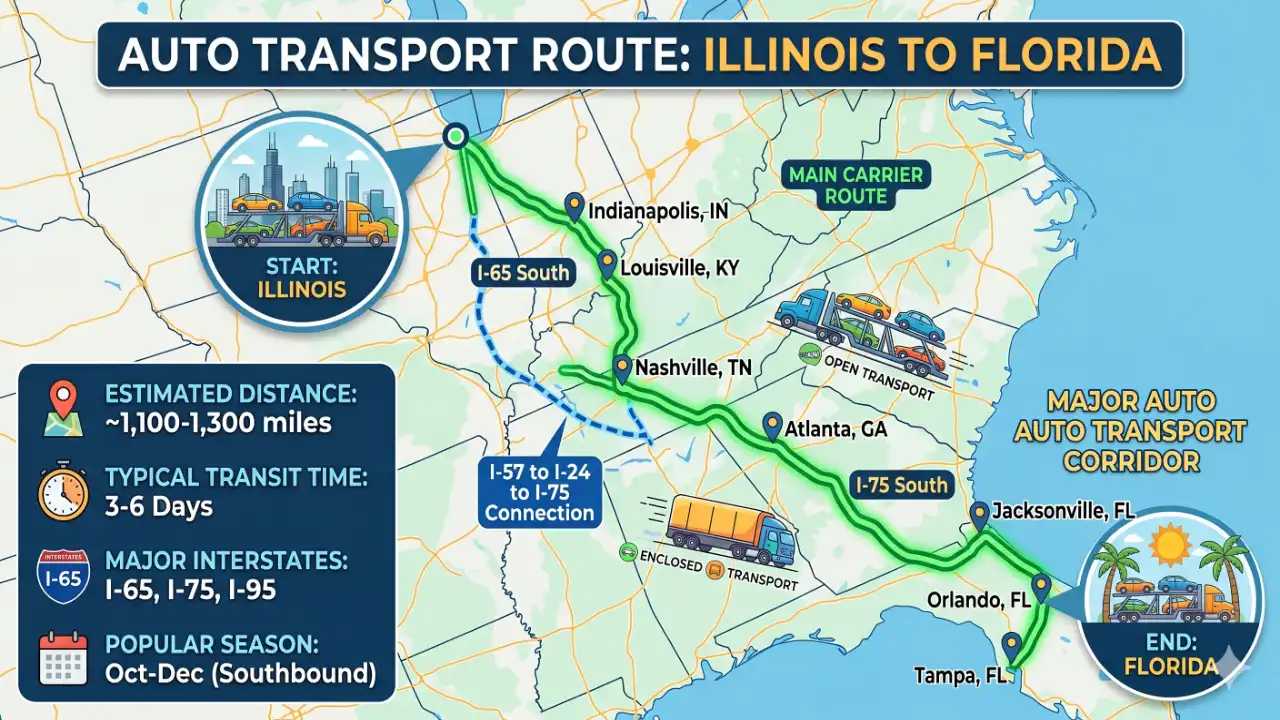
Car Shipping from Illinois to Florida is one of the busiest southbound corridors in the entire US auto transport industry. Every fall, tens of thousands of Illinoisans pack up and head south to escape brutal Chicago winters, subzero Peoria nights, and icy Springfield roads. The primary route runs south on I-57 through central Illinois, picks up I-24 through Kentucky and Tennessee, then transitions onto the legendary I-75 straight into Florida. That is roughly 1,250 to 1,350 miles of open road. Major origin cities include Chicago, Rockford, Naperville, and Springfield. Popular Florida destinations include Naples, Sarasota, Tampa, Orlando, and Fort Lauderdale. Car Shipping Hub moves hundreds of vehicles along this exact corridor every season. We know every mile of it. If you are tired of your car sitting in a snowdrift while you enjoy 80-degree weather, this guide walks you through everything you need to know.
Market Driver: Snowbird Seasonal Migration
Illinois ranks among the top five snowbird-origin states in the US. Retirees and remote workers flee Chicago's brutal winters for Florida's Gulf and Atlantic coasts every October through December. The reverse migration north kicks off in April. This creates a very predictable, highly seasonal demand curve that directly affects truck availability and pricing on this corridor. Book early or pay a premium — that is the reality of this route.
Why the I-75 Snowbird Corridor Never Slows Down
The Illinois to Florida auto transport lane is one of the most reliable in the country. Why? Because the demand never fully disappears. Snowbirds drive the fall surge. Families with college students at the University of Florida or Florida State fuel summer moves. Military families rotating into MacDill Air Force Base in Tampa or Patrick Space Force Base in Brevard County add steady year-round volume. This consistent traffic means Car Shipping Hub always has carriers running this lane. That translates directly into faster pickup times and more competitive rates for you. Whether you are heading to a condo in Naples or a rental in Orlando, this corridor has excellent truck coverage.
Rolling South on I-75: A Dispatcher's View of This Run
The primary artery for shipping a car from Illinois to Florida begins on I-57 Southbound out of the Chicago metro area. Drivers cut through Champaign-Urbana and continue south toward Carbondale. At the Missouri border region, the route transitions onto I-24 East through Paducah, Kentucky, and Nashville, Tennessee. From Nashville, carriers merge onto I-24 South toward Chattanooga before picking up I-75 South — the main artery running all the way to Miami. The stretch of I-75 through central Florida sees very heavy RV and snowbird traffic from October through January. Construction zones near Atlanta on I-75 frequently cause multi-hour delays. Plan for it.
✅ The Open Road Stretch
I-57 through central Illinois is flat, fast, and easy. Two-lane sections are wide and well-maintained. Carriers make excellent time here, especially overnight.
⚠️ The Atlanta Bottleneck
I-75 through the Atlanta metro is consistently ranked among the worst freight corridors in the Southeast. Construction, merges near I-285 (the Perimeter), and sheer volume of trucks slow this section considerably. Drivers often lose 2 to 4 hours here during peak hours.
🔴 The Gated Community Final Mile
Southwest Florida communities — Naples, Bonita Springs, Marco Island — are heavily gated. Many have strict HOA rules about commercial vehicle access. A full-size 18-wheeler auto transport carrier often cannot access these addresses directly. Your driver will coordinate a nearby meeting point, such as the Walmart Supercenter at 8049 Trail Blvd in Naples or the Home Depot on Collier Blvd.
From Lake-Effect Snow to Gulf-Coast Humidity: What Your Car Faces on This Run
When shipping a car from Illinois to Florida, your vehicle moves from one of the coldest, saltiest winter climates in the Midwest into a subtropical environment with intense humidity and afternoon thunderstorms. That contrast matters for your vehicle's condition during and after transport.
- Road salt corrosion: Illinois roads are heavily salted from November through March. Vehicles already coated in brine accumulate additional salt exposure during loading. A pre-ship wash is strongly recommended.
- Tennessee and Kentucky crosswinds: The I-24 corridor through the Tennessee Valley can see strong crosswinds, especially on open transport carriers. Lightweight vehicles and convertibles are more susceptible to road debris in this stretch.
- Florida hurricane season surges: From June through November, tropical storms can disrupt port cities and coastal delivery zones. Carriers serving Fort Lauderdale or Miami may face routing delays during active storm tracks.
Recommendation: For standard sedans and SUVs heading to inland Florida cities like Orlando or Tampa, open transport is completely adequate and cost-effective. If your destination is a coastal community like Sarasota, Naples, or Fort Lauderdale — or if you own a luxury vehicle, classic car, or exotic — choose enclosed transport. The salt air and storm debris risk along Florida's coasts justify the upgrade.
The I-75 Bait & Switch: How Shady Brokers Work This Lane
This is one of the highest-volume auto transport corridors in the US. High volume attracts low-quality brokers who post rock-bottom prices to capture your deposit — then cannot find a real carrier at that price. Here is how it plays out: you book with a broker quoting $750 for an Illinois to Florida shipment. They collect a $150 deposit. Three days before your pickup window, they call back with a 'price adjustment' to $1,100 because 'fuel costs went up.' You are now locked in with no refund and a tight move date. Car Shipping Hub does not operate that way. We quote based on current real-time carrier rates for the I-75 corridor — not a teaser number designed to win your click.
⚠️ Warning: If a quote looks too good to be true, verify the broker's MC number and bond status on the FMCSA website at safer.fmcsa.dot.gov before paying any deposit.
Chicago Suburb Pickups vs. Gated Gulf Coast Deliveries: What to Expect
Illinois Pickups: Chicago-area pickups work well from suburbs like Naperville, Schaumburg, or Oak Park where wide residential streets and large parking lots give carriers room to maneuver. In the dense city grid — think Wicker Park, Logan Square, or the Gold Coast — an 18-wheeler simply cannot safely park and load on a narrow street. Your driver will arrange a nearby staging area, typically a large retail parking lot like the IKEA on Clybourn Ave or a big-box store on the city's outer ring. Springfield and Rockford pickups are straightforward with excellent commercial access.
Florida Deliveries: Florida delivery logistics vary dramatically by destination. Tampa, Orlando, and Jacksonville have wide commercial corridors and excellent carrier access. Southwest Florida is a different story. Communities in Naples, Marco Island, and Bonita Springs are often gated with HOA-enforced access restrictions that prohibit commercial trucks. Carriers serving SunPass-tolled roads on Florida's Turnpike and I-75 Alligator Alley extension factor toll costs into the overall haul price. Always confirm whether your community allows commercial vehicle access before your delivery date.
What Car Shipping Hub Dispatchers Tell Every Illinois Client Before Fall
Pro Tip: Book your southbound shipment no later than September 15th if your target delivery window is October or November. The Illinois to Florida lane fills up faster than almost any other southbound corridor we manage. By mid-October, open-carrier spots are waitlisted and prices jump 15 to 25 percent over the base rate. If you are a returning snowbird who ships every year, call us in August. We lock in your rate and slot your pickup before the rush starts. Clients who wait until November 1st consistently pay more and wait longer. That is not a sales pitch — it is just the reality of how this market moves every single year.
What You Will Actually Pay: Illinois to Florida Pricing Broken Down by Season
The car shipping cost from Illinois to Florida ranges from $950 to $1,450 depending on the time of year, vehicle size, and transport type. Open transport on the I-75 corridor runs between $950 and $1,150 for a standard sedan during the off-peak summer months. That same sedan costs $1,200 to $1,450 during peak snowbird season from October through December. Enclosed transport adds a $350 to $500 premium on top of open rates — worth every dollar for classic cars, luxury vehicles, or anything you cannot risk getting road-chipped on an open carrier. Vehicle size is a major pricing variable. A full-size pickup truck or large SUV occupies more trailer space and weighs more, pushing costs higher. For the most accurate, real-time number on your specific vehicle and move date, use our Vehicle Shipping Quotes tool. It pulls live carrier rates for the Illinois to Florida lane and gives you a guaranteed, locked-in price — not an estimate that changes at pickup.
Estimated Transit Times: Illinois to Florida
Note: These are estimated transit times for standard dispatch. Severe weather, Atlanta traffic, or active hurricane advisories may impact actual delivery dates.
| Origin | Destination | Miles | Transit Time |
|---|---|---|---|
| Chicago, IL | Tampa, FL | 1,280 miles | 3 - 5 Days |
| Chicago, IL | Miami, FL | 1,370 miles | 4 - 6 Days |
| Springfield, IL | Orlando, FL | 1,100 miles | 3 - 5 Days |
| Rockford, IL | Naples, FL | 1,410 miles | 4 - 6 Days |
| Naperville, IL | Fort Lauderdale, FL | 1,340 miles | 4 - 6 Days |
Average Cost Ranges: Open vs. Enclosed Transport (Illinois to Florida)
Note: Prices shown are market averages for the IL to FL corridor. Actual rates vary due to fuel surcharges, vehicle condition, and seasonal demand. Contact Car Shipping Hub for a precise quote.
| Vehicle | Open | Enclosed | Why? |
|---|---|---|---|
| Sedan | $950 - $1,150 | $1,350 - $1,600 | Lower weight and compact size makes open transport efficient and affordable |
| Small SUV | $1,000 - $1,200 | $1,400 - $1,700 | Slightly more trailer space needed; open remains the smart value choice |
| Large SUV / Minivan | $1,100 - $1,350 | $1,550 - $1,900 | Height and weight increase fuel cost per mile on the I-75 haul |
| Pickup Truck | $1,150 - $1,400 | $1,600 - $1,950 | Bed length and truck height limit stacking on carrier; needs more space |
| Luxury / Exotic | $1,200 - $1,500 | $1,750 - $2,200 | Enclosed is strongly recommended; protects from road debris and Florida salt air |
Did You Know? The Numbers Behind This Migration Lane
Florida receives more in-bound relocations from Illinois than from any other Midwest state. According to US Census migration data, the Chicago-to-Florida pipeline is so consistent that auto transport carriers on the I-75 corridor refer to October through December as 'the green months' — the period where southbound loads are guaranteed and northbound loads are cheap or empty. This imbalance is exactly why shipping a car from Florida back to Illinois in January costs significantly less than the southbound trip.
Explore Related Routes
- Car Shipping from Kentucky to Florida
- Tennessee to Florida Auto Transport
- Check rates from Georgia to Florida
- Indiana to Florida car shipping
Ready to Escape the Illinois Winter?
Snowbird carrier slots on the I-75 corridor fill up weeks before the first frost hits Chicago — and once they are gone, prices jump fast. Get your guaranteed rate from Car Shipping Hub right now and secure your pickup date before the October rush locks you out.
How long does shipping a car from Illinois to Florida take?
Most Illinois to Florida shipments are completed in 3 to 6 days. The route covers roughly 1,250 to 1,350 miles depending on your specific origin and destination cities. Carriers average 400 to 500 miles per day on this run. The Atlanta metro on I-75 is the most common source of delays. During peak snowbird season in October and November, dispatch time — meaning how long before a carrier picks up your vehicle — can add 2 to 5 days to your overall timeline. Book early to avoid that wait.
How much does it cost to ship a car from Illinois to Florida?
Expect to pay between $950 and $1,450 for standard open transport on this route. The biggest pricing factor is season. October through December is peak snowbird season and prices climb 15 to 25 percent above summer rates. June and July are the cheapest months to ship because southbound demand drops significantly. Vehicle size also matters — a full-size truck costs more than a compact sedan. Enclosed transport adds roughly $350 to $500 on top of the open carrier rate.
Is enclosed transport necessary for the Illinois to Florida route?
For most everyday vehicles — sedans, standard SUVs, minivans — open transport is perfectly safe and is used by the vast majority of customers on this lane. Enclosed transport is recommended if you own a classic car, luxury vehicle, exotic, or anything with a custom paint job you cannot afford to risk. Florida's coastal salt air and the road debris common on I-75 through Georgia and Tennessee are the main reasons to consider the upgrade. If in doubt, ask your Car Shipping Hub coordinator and they will give you a straight answer based on your specific vehicle.
Can I pack personal items in my car when shipping to Florida?
Yes, you can usually pack up to 100 pounds of personal items in the trunk or cargo area. However, everything must stay below the window line so the driver can see safely. Personal items are not covered by the truck's cargo insurance. Do not leave valuables, electronics, or documents in the vehicle during transport.
Can I ship a car from Illinois to Florida if it does not run?
Yes, we can ship an inoperable vehicle. We just need to know in advance so we can send a truck equipped with a winch to safely pull your car onto the trailer. This adds a standard winch fee to your total cost. Make sure you disclose the inoperable status when requesting your quote so the right equipment is dispatched from the start.